
Wonder by R. J. Palacio is a novel about August Pullman, a ten-year-old boy with a facial difference who goes to school for the first time in fifth grade. For readers who want the plot, the narrators and the book's lesson on kindness.
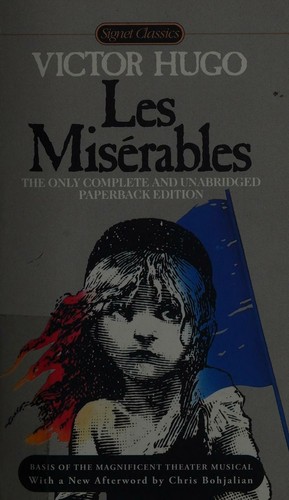
by Victor Hugo
1862 · 1468 pages · Summary updated 24 October 2026
Victor Hugo's novel about Jean Valjean, a convict who becomes a good man after one act of mercy, and the police inspector Javert who hunts him across France. For readers who want the five parts in order and the ideas behind the story.
Jean Valjean leaves prison in 1815 after nineteen years for stealing bread. A bishop forgives him for stealing his silver, and Valjean vows to become an honest man. Under a new name he grows rich and becomes a mayor, but Inspector Javert never stops hunting him. Valjean promises the dying Fantine, a factory worker forced into prostitution, that he will care for her daughter, Cosette. He rescues her from the cruel Thénardiers and raises her in hiding in Paris. Years later she falls in love with Marius, a young student caught up in the uprising of 1832. Victor Hugo writes about poverty, law, mercy and redemption.
Nineteen years in the galleys make Jean Valjean hard and bitter. One act of mercy changes him: Bishop Myriel tells the police that the stolen silver was a gift and gives him the candlesticks as well. Valjean spends the rest of his life repaying that mercy to others, from Fantine to Javert. Hugo argues that punishment alone produces criminals, while forgiveness can produce good men. The candlesticks follow Valjean through the novel and light his deathbed.
Javert is honest, brave and incorruptible. He believes that the law is always right and that a criminal can never change. He hunts Valjean for years. When Valjean spares his life at the barricade, Javert's belief system collapses: a convict has acted more justly than the law. Hugo uses him to show that a rigid sense of justice can become its own kind of injustice. Javert is not a villain but a man with no room for grace.
Valjean steals bread to feed seven hungry children. Fantine sells her hair, her teeth and her body to pay for her daughter's care. Gavroche lives on the street. Hugo shows how society first makes people desperate and then condemns them for what desperation drives them to do. His preface says books like this will be needed as long as poverty, ignorance and the degradation of men and women exist. The title, the wretched, includes both the poor and the criminals.
When an innocent man, Champmathieu, is about to be convicted as Jean Valjean, Monsieur Madeleine spends a night in agony. If he stays silent, the town keeps its prosperous factory and its kind mayor. If he speaks, he loses everything. Hugo calls the chapter a tempest in a skull. Valjean goes to Arras and confesses. Hugo shows that the hardest moral battles take place inside one person, with no audience, and that goodness means accepting a cost.
Valjean has never loved anyone before he takes eight-year-old Cosette from the Thénardiers. She gives him a reason to live, and he gives her the childhood she lost. Hugo shows how a parent's love can redeem both people, but also how it can become possessive: Valjean fears losing Cosette to Marius. His final sacrifice is to let her go. The novel treats love not as romance alone but as the daily work of care.
The Friends of the ABC build a barricade in June 1832 to bring the republic. Paris does not rise with them, and they die almost to a man. Hugo describes their courage and their naivety with equal care, and Gavroche's death collecting cartridges is one of the book's most famous scenes. He argues that their sacrifice was not wasted, because progress moves through such defeats. He also shows the cost: young lives spent on a battle they could not win.
After Cosette marries, Valjean confesses his past to Marius, who pushes him away. Valjean accepts it without defending himself. Only when Thénardier tries to blackmail Marius does Marius learn that Valjean carried him through the sewers and that his fortune was honest. Marius and Cosette reach Valjean as he dies by the bishop's candlesticks. Hugo ends with an unmarked grave. The man who changed through mercy asks for no reward and is redeemed by love.
Les Misérables by Victor Hugo came out in 1862, while Hugo lived in exile on the island of Guernsey for opposing Napoleon III. The title means "the wretched" or "the poor ones." The book was an immediate international success, and it remains one of the longest novels most readers know by name. It runs to about 1,400 pages in most complete English editions. This summary follows the unabridged novel. The Signet Classics edition uses the Charles Wilbour translation of 1862 as revised by Lee Fahnestock and Norman MacAfee; Christine Donougher and Julie Rose have made newer translations.
Hugo divides the novel into five parts, named after characters or events: Fantine, Cosette, Marius, The Idyll in the Rue Plumet and the Epic of the Rue Saint-Denis, and Jean Valjean. The story runs from 1815 to 1833. Hugo also stops the story for long essays: on the Battle of Waterloo, on convents, on the Paris sewers, on slang and on the politics of the 1830s. Many abridged editions cut these.
Hugo says in his preface that as long as poverty, ignorance and the degradation of men, women and children exist, books like this one will be needed. The main themes are the power of mercy against the law, the injustice of poverty, redemption and the love between parents and children.
The book opens with a long portrait of Bishop Myriel of Digne, a humble, generous man who gives away most of his income and keeps only his silver plates and two silver candlesticks.
In October 1815, Jean Valjean arrives in Digne. He was a poor tree pruner who stole a loaf of bread to feed his sister's seven children. He was sentenced to five years in the galleys at Toulon, and his escape attempts raised the total to nineteen. He carries a yellow passport that marks him as a former convict, and every inn turns him away. The bishop welcomes him, feeds him and gives him a bed. In the night Valjean steals the silver and runs. Police catch him and bring him back. The bishop tells them the silver was a gift and hands Valjean the candlesticks too, saying he forgot to take them. He tells Valjean to use the silver to become an honest man and that he has bought his soul for God.
Shaken, Valjean leaves. On the road he steps on a coin dropped by a boy, Petit-Gervais, and refuses to give it back. When the boy runs off crying, Valjean is struck by what he has done. He searches for the boy in vain and weeps for the first time in nineteen years. He decides to change.
In Paris, a young working woman, Fantine, is seduced and abandoned by a wealthy student, Tholomyès, with a baby daughter, Cosette. She leaves the child with an innkeeper couple, the Thénardiers, in the village of Montfermeil, and pays them to care for her. They treat Cosette as a servant and keep demanding more money.
Fantine finds work in the town of Montreuil-sur-Mer, in a factory owned by Monsieur Madeleine. Madeleine arrived years before, invented a cheaper way to make black glass beads and made the town rich. He is generous, modest and has been elected mayor. He is Jean Valjean.
The police inspector, Javert, was a guard at Toulon. He is rigid, honest and believes the law is always right. When Madeleine lifts a heavy cart to free a trapped old man, Fauchelevent, Javert remembers only one convict with that strength.
A forewoman learns that Fantine has a child out of wedlock and dismisses her. Fantine sinks into poverty. To pay the Thénardiers, she sells her hair, then her two front teeth, then herself. When a young man pushes snow down her back and she attacks him, Javert arrests her. Madeleine orders her released. She spits in his face, blaming him for her fall. He learns her story and promises to bring Cosette to her. Fantine falls ill.
Javert then tells Madeleine that he wrongly suspected him: the real Jean Valjean has been arrested under the name Champmathieu and will be sent back to the galleys for life. Madeleine spends a night of agony, which Hugo calls a tempest in a skull. If he stays silent, he keeps his good work and an innocent man suffers. He travels to the trial in Arras and declares that he is Jean Valjean. Champmathieu goes free. Javert arrests Valjean at Fantine's bedside, and she dies of the shock. Valjean escapes, is recaptured and is sent back to Toulon. There he saves a sailor from falling from a ship's rigging, then falls into the sea himself. He is reported drowned.
Hugo pauses for a long account of the Battle of Waterloo in 1815. At the end, a looter robbing the dead on the battlefield revives a wounded French officer, Colonel Georges Pontmercy, who thinks the looter saved his life. The looter is Thénardier.
On Christmas Eve 1823, eight-year-old Cosette is sent into the dark woods to fetch water. A stranger takes the heavy bucket from her. It is Valjean, who survived his fall into the sea. At the inn he buys her the expensive doll she has been staring at in a shop window, pays the Thénardiers fifteen hundred francs and takes her away.
In Paris they live in the run-down Gorbeau house. Valjean gives Cosette the love she has never had, and she gives him a reason to live. Javert tracks them down. Valjean flees with Cosette through the night streets and climbs a wall into a convent garden, the Petit-Picpus convent. The gardener there is Fauchelevent, the man he saved from the cart. To enter the convent legally, Valjean has himself carried out in a coffin and nearly buried alive, then returns through the front gate as Fauchelevent's brother. For several years Valjean works as a gardener, and Cosette is educated by the nuns.
The story jumps forward to around 1830. Marius Pontmercy is a young man raised by his rich royalist grandfather, Monsieur Gillenormand. His father, Colonel Pontmercy, was one of Napoleon's officers, and Gillenormand kept them apart. On his father's death Marius learns that he loved him from a distance. Marius becomes an admirer of Napoleon, quarrels with his grandfather and leaves home to live in poverty as a law student. His father's last note asks him to repay a debt of honor to a Sergeant Thénardier who saved his life at Waterloo.
Marius makes friends with a group of republican students, the Friends of the ABC, led by the stern, idealistic Enjolras. Among them are the gentle Combeferre, the cheerful Courfeyrac and the drunken skeptic Grantaire, who believes only in Enjolras.
In the Luxembourg Gardens, Marius sees an old man walking with a young girl. A year later the girl has grown into a beautiful young woman. She is Cosette, and the old man is Valjean. Marius falls in love from a distance.
Marius lives in the Gorbeau house. His neighbors are a poor, scheming family called Jondrette. Through a hole in the wall he sees that they are the Thénardiers, ruined and living on fraud, with their daughter Éponine, who loves Marius in silence. Thénardier recognizes Valjean as a charitable visitor and plans to trap and rob him with a gang of criminals, Patron-Minette. Marius warns Javert, then hesitates to give the signal, because Thénardier is the man his father asked him to repay. Javert raids the room anyway and arrests the gang. Valjean escapes through the window.
Valjean and Cosette now live in a quiet house with a wild garden in the Rue Plumet. Éponine finds the address for Marius, out of love for him. Marius and Cosette meet in the garden at night and declare their love. Éponine, in secret, stops her father's gang from robbing the house.
The Thénardiers' neglected son Gavroche, a cheerful street boy, lives in the plaster elephant at the Place de la Bastille and shelters two smaller boys who, unknown to him, are his brothers.
Valjean, troubled by political unrest and a warning note from Éponine, decides to move to England. Cosette leaves a message for Marius. Marius asks his grandfather for permission to marry. Gillenormand suggests he make Cosette his mistress instead. Marius leaves in despair.
In June 1832, the funeral of General Lamarque, a popular opponent of the king, becomes an uprising. The Friends of the ABC build a barricade in the Rue de la Chanvrerie, near a wine shop called the Corinthe. Gavroche joins them and unmasks a spy: Javert. They tie him up to shoot him later. Éponine, dressed as a boy, lures Marius to the barricade because she would rather die with him than see him with Cosette. When soldiers attack, Marius saves the barricade by threatening to blow it up with a keg of gunpowder. Éponine takes a bullet meant for him. Dying, she gives him Cosette's letter and confesses her love. Marius writes a farewell to Cosette, and Gavroche delivers it to Valjean.
This section reveals the ending.
Valjean has already learned from a blotter that Cosette loves Marius. The letter tells him Marius expects to die. He goes to the barricade in a National Guard uniform. He asks for the right to execute Javert, takes him into an alley, fires into the air and lets him go, giving his address. Javert cannot understand mercy from a convict.
At dawn Gavroche goes beyond the barricade to collect cartridges from dead soldiers and is shot while singing a mocking song. The army attacks with cannon. The students die one by one. Enjolras faces a firing squad, and Grantaire, who slept through the battle, wakes and asks to die with him. Valjean picks up the wounded, unconscious Marius and escapes into the sewers.
He carries Marius through miles of dark tunnels and nearly drowns in a pit of mud. At the exit grate he meets Thénardier, who has the key. Thénardier thinks Valjean is a murderer hiding a body, lets him out for money and secretly tears a piece from Marius's coat. Outside waits Javert. Valjean asks to take Marius home to his grandfather. Javert agrees and lets Valjean go. His whole belief in the law has broken: he owes his life to a criminal and has let a criminal go. He cannot live with this. He throws himself into the Seine.
Marius recovers after months. Gillenormand, overjoyed, consents to the marriage. Valjean gives Cosette a dowry of nearly six hundred thousand francs, the money he saved as Madeleine. Marius and Cosette marry in February 1833. Valjean then tells Marius that he is a former convict. Marius, horrified, slowly pushes him out of Cosette's life. Valjean, alone, stops eating and grows weak.
Thénardier comes to Marius under a false name to sell a secret: Valjean is a murderer, and here is a piece of the coat of the man he killed. Marius recognizes the cloth as his own. He realizes that Valjean saved his life and that Valjean's fortune was honest. He pays Thénardier to leave France; Thénardier goes to America and becomes a slave trader. Marius and Cosette rush to Valjean. They find him dying. He tells Cosette her mother's name, Fantine, and dies in their arms, by the light of the bishop's candlesticks. He is buried in an unmarked grave.
Some early critics, including Gustave Flaubert, found the book sentimental and its characters too good or too evil. Many readers since have found the essays on Waterloo, convents and the sewers long, which is why abridged editions are common. Others argue those essays are the point: Hugo wanted a total picture of French society. The novel's social message was praised by reformers and attacked by conservatives. It became the source for the 1980 stage musical and many films.
Read it if you want the story behind the musical, or if you are studying the novel and need the five parts in order. It suits anyone interested in mercy, justice and what a society owes its poorest people.
12 cards
Question 1 of 5
What does Bishop Myriel give Valjean when the police bring him back?
Valjean carries the wounded Marius through the sewers. Javert, unable to reconcile mercy with the law, drowns himself. Marius marries Cosette, then pushes Valjean away after learning he was a convict. When Thénardier's blackmail reveals that Valjean saved him, Marius and Cosette rush to him, and Valjean dies in their arms by the bishop's candlesticks.
Wonder by R. J. Palacio is a novel about August Pullman, a ten-year-old boy with a facial difference who goes to school for the first time in fifth grade. For readers who want the plot, the narrators and the book's lesson on kindness.

Ugly Love is Colleen Hoover's romance about Tate Collins, a nursing student who agrees to a no-strings affair with a guarded airline pilot, Miles Archer, whose past is a closed door. For readers who want a steamy, emotional love story with a heartbreaking backstory.
Zora Neale Hurston's novel about Janie Crawford, a Black woman in early 1900s Florida who moves through three marriages in search of real love and her own voice. For readers who want the plot, the themes and the meaning of the title.

The Wife Upstairs is Rachel Hawkins's 2021 thriller that retells Jane Eyre in a wealthy Alabama suburb, where a broke dog walker falls for a widower whose wife vanished on a lake. For readers who like twisty domestic suspense.
More in Fiction →More in Philosophy and stoicism →More in Society and history →
New books, occasionally