
Wonder by R. J. Palacio is a novel about August Pullman, a ten-year-old boy with a facial difference who goes to school for the first time in fifth grade. For readers who want the plot, the narrators and the book's lesson on kindness.
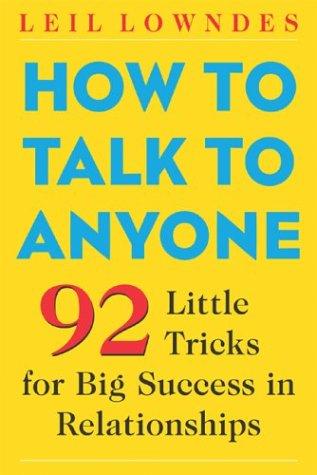
by Leil Lowndes
2003 · 368 pages · Summary updated 24 October 2026
How to Talk to Anyone: 92 Little Tricks for Big Success in Relationships by Leil Lowndes gives short, named techniques for first impressions, small talk, rapport, praise, phone calls and parties. For anyone who feels awkward with new people.
Leil Lowndes argues that people who seem naturally confident use small, learnable habits. She packs them into 92 named tricks in nine parts. Body language comes first: a slow "flooding smile," "sticky eyes" that hold contact a beat longer, and a full turn toward each new person. Then come tricks for small talk, such as "parroting" a person's last words and never giving a "naked" job title. Later parts cover sounding like an insider, building instant rapport, praising without flattery, phone manners and working a party. The goal is to make people feel important, so they want to know you.
Lowndes's first trick is the flooding smile. Instead of smiling the moment you see someone, look at their face for about a second. Then let a big, warm smile spread across your face and into your eyes. The pause tells the person the smile is for them, not an automatic reflex. She argues that this small change makes you seem sincere and makes a strong first impression.
With sticky eyes, you keep looking at the other person after they finish speaking, then look away slowly, as if your eyes stick to them. With epoxy eyes, you watch your target even while others talk. Lowndes says strong eye contact signals intelligence and interest. She warns that epoxy eyes carry romantic meaning, so use them with care. Practice both with friends first, until they feel natural.
The big-baby pivot means turning your whole body toward a person you meet, the way people turn to look at a baby. Many people turn only their heads and keep their bodies pointed elsewhere. A full turn shows the person has your complete attention. Lowndes pairs it with posture: stand tall, as if hanging by your teeth from a bar, and keep your hands away from your face.
When someone asks where you are from or what you do, a bare answer like "Ohio" or "I'm an accountant" ends the conversation. Lowndes says to add a colorful detail that gives the other person something to ask about. The same rule applies when you introduce people: add a fact about each one so they can start talking. Small talk works best when you hand people easy openings.
When a conversation stalls, repeat the last few words the other person said, with a curious tone. If they say they just got back from a conference, you say, "A conference?" They will usually explain more. Lowndes says this works because people love to talk about themselves. It also buys you time when you do not know what to say.
Lowndes argues that people trust those who seem similar. Echo the exact words a person uses, mirror their pace and posture in a subtle way, and choose examples from their world rather than yours. Use "we" early to suggest a shared bond, and create a small shared memory from your first meeting that you can refer to later. These cues make a new acquaintance feel like an old friend.
Lowndes separates praise from flattery. Grapevine glory means praising someone to a third person who will pass it on, because praise heard secondhand feels sincere. Carrier pigeon kudos means passing on compliments you hear about someone. The killer compliment is one specific, unique, private compliment, used rarely. Specific, indirect praise makes people feel valued without making you look like a flatterer.
At events, write a few notes on a person's business card right after you talk. Later, ask about the things they mentioned: their child's game, their trip, their new project. Lowndes calls this tracking. It shows you listened and that they matter to you. She treats social skill as something you can plan, just like any other part of your work.
How to Talk to Anyone: 92 Little Tricks for Big Success in Relationships by Leil Lowndes is a practical guide to conversation and first impressions. It came out in 2003 as a revised version of her earlier book Talking the Winner's Way. Lowndes is a communication coach and speaker. She noticed that some people walk into a room and seem to connect with everyone, and she wanted to know what they do differently.
Her answer is that they use many small habits, most of them unconscious. She breaks these habits into 92 tricks, each with a short, memorable name. The tricks are grouped into nine parts. Each trick gets a few pages: a story, the reasoning behind it, and a one-line instruction. The idea is that you do not need to change your personality. You need a set of tools you can use one at a time.
The common thread is that people care most about themselves. If you make them feel noticed and important, they will like you and remember you.
Lowndes starts with body language, because people judge you before you speak.
This part tackles small talk. Lowndes says the words matter less than the mood. Match the other person's energy first.
This part is about sounding confident and interesting.
Lowndes argues that people feel close to those who seem like them.
In Part 4, she suggests learning a little of the jargon and hot issues of other people's fields. Before you meet a group of lawyers or nurses, find out what they talk about. Read their trade magazines. Try something new outside your routine now and then, which she calls scramble therapy, so you have more to talk about.
Part 5 covers rapport:
Lowndes separates sincere praise from empty flattery.
The phone section asks you to put your gestures into words, since the listener cannot see you. Use the caller's name, sound happy when you hear who it is, and ask whether it is a good time to talk. Some of this advice, written for landlines, secretaries and voicemail greetings, feels dated.
The party section treats a party as a skill. Eat before you go so your hands are free. Pause at the door and rubberneck the room to see who is there. Keep your arms open. Write notes on business cards right after a conversation, and use tracking: remember details of people's lives and ask about them later.
The final tricks cover influence with important people. Explain what is in it for them, and wait before you ask for a second favor. Keep parties for fun, not tough business. Let people say everything they want to say before you give your ideas. When you make a mistake, make sure the other person comes out ahead.
Readers often praise the book's clear, named tricks, which are easy to remember and try. Critics note that much of the advice is based on anecdote rather than research, and some claims draw on ideas, such as matching a person's visual, auditory or kinesthetic style, that have weak scientific support. Others find some tricks manipulative or awkward if used mechanically, and the phone and office advice is dated.
Read it if you feel awkward at networking events, parties or first meetings and want concrete steps to try. Pick two or three tricks at a time and practice them until they feel natural.
12 cards
Question 1 of 5
What makes the flooding smile different from a normal smile?
Wonder by R. J. Palacio is a novel about August Pullman, a ten-year-old boy with a facial difference who goes to school for the first time in fifth grade. For readers who want the plot, the narrators and the book's lesson on kindness.

Ugly Love is Colleen Hoover's romance about Tate Collins, a nursing student who agrees to a no-strings affair with a guarded airline pilot, Miles Archer, whose past is a closed door. For readers who want a steamy, emotional love story with a heartbreaking backstory.
Zora Neale Hurston's novel about Janie Crawford, a Black woman in early 1900s Florida who moves through three marriages in search of real love and her own voice. For readers who want the plot, the themes and the meaning of the title.
The Wife Upstairs is Rachel Hawkins's 2021 thriller that retells Jane Eyre in a wealthy Alabama suburb, where a broke dog walker falls for a widower whose wife vanished on a lake. For readers who like twisty domestic suspense.
More in Communication and persuasion →More in Relationships →
New books, occasionally