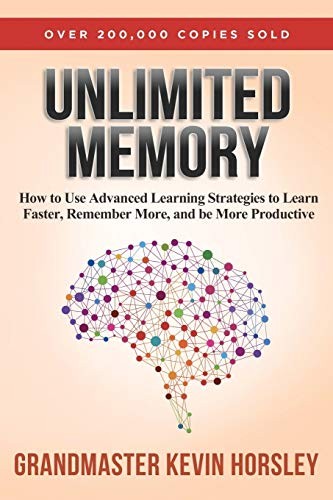
Unlimited Memory by Kevin Horsley teaches the techniques memory champions use, from the SEE principle to the memory palace, in a short practical guide. For students and professionals who want to learn faster and remember more.
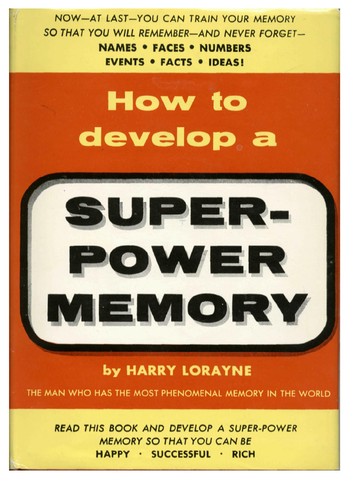
1957 · 217 pages · Summary updated 24 October 2026
How to Develop a Super-Power Memory by Harry Lorayne is the 1957 memory classic that teaches the Link system, the Peg system and substitute words for names, numbers, cards and speeches. For anyone who wants practical memory techniques.
Harry Lorayne, a stage memory performer, argues that there is no bad memory, only a trained or an untrained one. We already remember by association, but by accident. He teaches you to associate on purpose. First observe and want to remember. Then use the Link system: chain items in order with ridiculous mental pictures. Learn a phonetic alphabet that turns digits into consonant sounds, and fixed peg words (1 tie, 2 Noah, 3 ma) to hold items by number. Use substitute words to picture names and abstract terms, and link each name to a feature of the face. The same tools cover long numbers, cards, dates, speeches, errands and appointments.
Lorayne's starting claim is that memory is a skill. Untrained memories are one-sided: people who remember faces forget numbers, and the reverse. Everything we remember, we remember by association, but usually by accident. His system makes association conscious. He adds that, with practice, the conscious method becomes almost automatic. Six tests at the start of the book measure the untrained memory, and later chapters tell you when to retake them so you can see the improvement.
Most people cannot say which light is on top of a traffic light, though they see one every day. Lorayne's point is that we see without observing. Interest drives attention: in his bus puzzle, readers count passengers and miss that the driver is "you." So the first step is to want to remember and to expect that you will. He argues that forgetting is often a failure to remember in the first place, and that writing everything down replaces the effort that builds memory.
To remember items in order, join each item to the next with an absurd mental image, then move on to the next pair. In his 20-item example, a carpet made of paper crinkles underfoot, a bottle pours out paper and you sleep in a giant bottle instead of a bed. A logical picture will not stick. Four rules help: make items out of proportion, add action, exaggerate the number and substitute one item for the other. Each item then recalls the next, forward or backward.
Numbers are abstract and hard to picture. Lorayne gives each digit a consonant sound: 1 is T or D, 2 is N, 3 is M, 4 is R, 5 is L, 6 is J or sh, 7 is K or hard g, 8 is F or V, 9 is P or B and 0 is S or Z. Vowels and w, h and y do not count, and only sound matters, not spelling. With these sounds, any number becomes a word you can picture. The method is now usually called the major system.
From the phonetic alphabet, Lorayne builds fixed peg words: 1 tie, 2 Noah, 3 ma, 4 rye, 5 law, 6 shoe, 7 cow, 8 ivy, 9 bee and 10 toes, growing to 100. To store item 9 as a purse, picture bees swarming out of a purse. Because the pegs never change, you can recall the list in order, backward or at random, and name the number of any item. The pegs also carry phone numbers, long numbers, dates and appointments.
When a word means nothing to you, find a word or phrase that sounds like it and can be pictured. Lorayne remembered the caudal fin of a fish as a cord for a tail and the dorsal fin as Tommy Dorsey playing a trombone on the fish's back. The Spanish word for bird, pajaro, becomes a parked car full of birds. The substitute does not need to be exact. It only needs to bring the real word back when you see the picture.
Most people forget names because they never heard them properly. Lorayne's first rule is to make sure you hear the name, then spell it, comment on it and use it. Next, turn the name into a picture, using a substitute word if needed. Choose the feature that stands out to you on the face, and join the two with an absurd image. Mr. Sachs has a high forehead, so you see sacks pouring from it. The face then calls up the name.
For a speech, do not memorize words. Pick one key word for each thought and link the key words, so the thoughts come in order and the words follow. For errands, link the tasks or hang them on pegs and check the list during the day. For appointments, number the weekdays from Monday as 1 and combine day and hour into a peg: Wednesday at 4:00 is 34, mower. Absent-mindedness is inattention, so make a conscious association at the moment you act.
“There is no such thing as a poor memory, only a trained or untrained one.”
How to Develop a Super-Power Memory by Harry Lorayne came out in 1957 from the publisher Frederick Fell. Lorayne was an entertainer who performed memory feats at hotels, clubs and company dinners. He writes in a chatty, informal style, as if he were sitting in the reader's living room. He skips brain science on purpose. He says he is a performer, not a doctor, and that he teaches only the methods he uses himself.
His central claim comes early: there is no such thing as a poor memory, only a trained or an untrained one. Untrained memories are one-sided. People who remember faces forget phone numbers, and the reverse. The cure is conscious association. We already remember things by connecting them to what we know, but we do it without noticing. Lorayne teaches readers to do it on purpose. He also argues that, with practice, the conscious method becomes automatic.
The book has 26 short chapters, and most open with a joke. Six tests near the start measure the untrained memory: a list of 15 objects, 20 objects by number, a 20-digit number, five missing cards from a deck, 15 faces with names, and ten phone numbers. Later chapters tell the reader when to retake each test, so progress shows on paper.
The first chapters lay the groundwork. Lorayne opens with observation tests. Which light is on top of a traffic light? Is the six on your watch an Arabic or a Roman numeral? Most people are not sure, though they see both every day. His point is that we see but do not observe, and we cannot remember what we never observed.
Association is the second foundation. He reminds readers of school aids they still know: "Every Good Boy Does Fine" for the lines of the treble clef, FACE for the spaces, and the boot shape of Italy. Each one ties a new, meaningless thing to something already known.
Interest is the third. In a trick question, he describes a bus and its passengers getting on and off, then asks for the driver's name. The reader is busy counting passengers and misses that the first word of the story is "you." People remember what they care about. So the first rule is to want to remember and to trust that you will. He also argues that writing everything down weakens memory, because the note replaces the effort. In his view, "I forgot" usually means "I never remembered in the first place."
The Link system is for remembering things in sequence. Lorayne gives a list of 20 items: carpet, paper, bottle, bed, fish, chair, window, telephone, cigarette, nail, typewriter, shoe, microphone, pen, television set, plate, donut, car, coffee pot and brick. You join each item to the next with a ridiculous mental picture. A carpet made of paper crinkles under your feet. A bottle pours out paper instead of liquid. You sleep in a giant bottle instead of a bed. After each picture, you forget the earlier item and join only the next pair.
A logical picture, such as paper lying on a carpet, will not work. The picture must be absurd, and you must actually see it for a moment. To help, he gives four rules:
When the chain is built, each item brings back the next. The list comes back forward and also backward. If you struggle to recall the first item, he suggests linking it to the person who is testing you.
The Link handles order. The Peg system handles numbers, and it lets you recall items in and out of order. Lorayne traces the idea to Stanislaus Mink von Wennsshein around 1648 and to Richard Grey in 1730. Today the method is often called the major system.
It starts with a phonetic alphabet of ten consonant sounds, one for each digit, each with a small aid:
Vowels and the letters w, h and y count for nothing. Only the sound counts, not the spelling. With these sounds, any number can become a word. Lorayne then gives fixed peg words: 1 tie, 2 Noah, 3 ma, 4 rye, 5 law, 6 shoe, 7 cow, 8 ivy, 9 bee and 10 toes. The list grows in stages to 100.
To remember that item 9 is a purse, you join "bee" to purse: a swarm of bees flies out of your purse and stings you. Because each peg is fixed, you can call the items in order, backward or at random. You can also name the number when someone gives you the item. Lorayne compares the pegs to hooks in a bare wall, ready for anything you want to hang on them.
The third tool is substitute words. For anything abstract, find a word or phrase that sounds like it and can be pictured. Lorayne learned the fins of tropical fish this way. The caudal fin became a cord in place of a tail. The dorsal fin became bandleader Tommy Dorsey playing a trombone on the fish's back. The Spanish word for bird, pajaro, sounds like "parked car," so you picture a parked car crammed with birds.
Names get three chapters, because Lorayne says most of his students come to him for help with them. His first rule needs no system: be sure you hear the name in the first place. Ask the person to repeat or spell it, comment on it, use it during the talk and use it again when you say goodbye.
Then the system. Some names already mean something (Baker, Fox, Gold). Some suggest a picture (Lincoln). The rest need a substitute word. Next, look at the face and choose one outstanding feature, such as a high forehead, a cleft chin or bushy eyebrows. Join the substitute word to that feature with an absurd picture. Mr. Sachs has a high forehead, so you see sacks falling from it. Later, the face calls up the name. Lorayne reports meeting 100 to 200 guests at a dinner and then calling each of them by name in his show.
The middle chapters apply the Peg and Link systems to harder material.
Lorayne admits that many of these are stunts. He argues that they are good practice and that the same ideas apply at work.
The practical chapters are short. For errands, link the tasks or hang them on pegs, then run through them during the day to see what is left. For speeches, do not memorize the words. Choose a key word for each thought and link the key words. The thoughts come back in order, and the words take care of themselves. The same method works for articles, scripts and jokes. His magazine stunt hangs the main picture on each page on the peg for that page number.
He treats absent-mindedness as inattention, not a poor memory. You lose your glasses because you put them down without thinking. The fix is a conscious association at the moment of action. To remember to take a letter, link it to the last thing you see when you leave home, such as the doorknob. For appointments, he numbers the weekdays from Monday as 1 and combines the day and the hour into a peg word: Wednesday at 4:00 is 34, "mower." The last chapter lists more targets, such as prices, style numbers, state capitals and calories.
The core methods hold up. Laboratory studies since the 1960s find that peg and link mnemonics improve recall of lists, and the keyword method, a close relative of substitute words, helps people learn foreign vocabulary. Research is less firm on his insistence on ridiculous images: the interaction between the two items seems to matter more than oddness, and bizarre images help mostly when they stand out among ordinary ones. Some claims are overstated, such as the idea that memory has no limit or that we use only a small part of our brain power. The examples are dated (telephone exchanges, cigarette tax stamps, typewriters), and the systems help most with arbitrary facts rather than understanding. Lorayne later reworked the same systems in The Memory Book (1974) with Jerry Lucas, which became his best-known book.
Read it if you want the classic Link and Peg systems from one of the people who made them popular, in a short and chatty form. Expect dated examples and stage stunts, and expect to do the exercises, because the systems work only with practice.
12 cards
Question 1 of 5
What is the main use of the Link system?
Unlimited Memory by Kevin Horsley teaches the techniques memory champions use, from the SEE principle to the memory palace, in a short practical guide. For students and professionals who want to learn faster and remember more.
The Daily Stoic by Ryan Holiday and Stephen Hanselman offers 366 daily meditations from Marcus Aurelius, Seneca and Epictetus, organized by monthly themes. For anyone who wants a daily habit of Stoic reflection.
Robert A. Glover's No More Mr. Nice Guy describes Nice Guy Syndrome: men who seek approval, hide flaws and put others first, then feel resentful. For men stuck in people-pleasing who want more honest relationships.

Models by Mark Manson is a dating guide for men that replaces pickup tactics with honesty: become non-needy, show vulnerability, polarize, and build a life worth sharing.
New books, occasionally