
Paul Kalanithi's memoir of training as a neurosurgeon, being diagnosed with stage IV lung cancer at 36, and deciding how to live in the time left. For readers who want a doctor's account of facing death.
2024 · 400 pages · Summary updated 24 October 2026
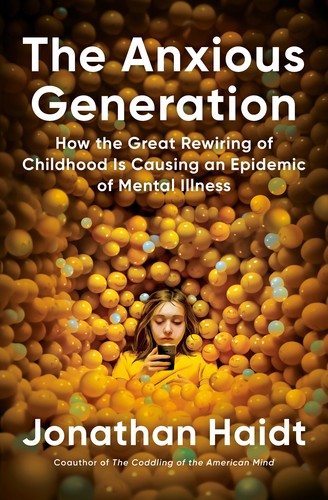
Jonathan Haidt's case that smartphones and overprotection rewired childhood after 2010 and drove a surge in teen anxiety. For parents, teachers and anyone weighing the research dispute around it.
Haidt argues that teen mental health collapsed after 2012 because two trends collided: adults began overprotecting children in the real world in the 1980s and 1990s, then underprotected them online when smartphones and social media arrived. The play-based childhood gave way to a phone-based childhood. He names four foundational harms: social deprivation, sleep deprivation, attention fragmentation and addiction. Girls suffer most from social media, boys from withdrawal into games and porn. His fix is four norms: no smartphones before high school, no social media before 16, phone-free schools and far more unsupervised play. Researchers such as Candice Odgers say the causal evidence is weaker than Haidt claims.
Haidt dates the shift not to the iPhone's release in 2007 but to the years when front-facing cameras, Instagram, mobile data and app-based social media reached most teens. By 2015 the majority of American girls used Instagram daily. Rates of teen depression, self-harm and suicide, flat through the 2000s, turned upward at the same point, and similar turns appear in Canada, the UK, Australia and the Nordic countries. Haidt argues that a sudden international shift points to a shared cause.
Like the immune system, children grow stronger through exposure to manageable stress and weaker when shielded from it. Free play teaches conflict, fear management and recovery from failure. Haidt contrasts discover mode, where children explore and take chances, with defend mode, where they scan for threats. He cites Lenore Skenazy, attacked in 2008 for letting her nine-year-old ride the subway alone, to show how far safetyism had gone before phones arrived.
Haidt's central frame is a double error. From the 1980s, parents cut unsupervised play, walking to school and independent errands because of exaggerated fears about strangers. Then, around 2010, they handed children devices with unrestricted access to adult strangers, pornography and engagement-optimized feeds. The first error emptied childhood of real experience. The second filled the gap with a phone. He argues that puberty is a sensitive period, so a teen who spends it on a phone wires for the phone.
Haidt names harms that apply regardless of content: social deprivation, as time with friends in person fell after 2012; sleep deprivation from phones in bedrooms; attention fragmentation from hundreds of daily notifications; and addiction, because apps use variable-ratio rewards like slot machines. He calls phones experience blockers. The damage is not only what children see but what the phone crowds out: play, sleep, boredom and face-to-face conversation.
Haidt gives four reasons. Girls are more sensitive to visual social comparison, and Instagram is built on curated images. Girls' aggression is relational, and social media is a tool for exclusion and shaming. Girls share emotions more, which spreads distress, as in the wave of tic symptoms among girls watching tic videos on TikTok. And girls face more harassment from adult men. Surveys show heavy users of social media are two to three times more likely to be depressed, with the effect concentrated among girls.
Boys' decline looks different and started earlier. Haidt argues that boys have lost ground in school and work since the 1970s, and that video games, pornography and online communities offered a low-cost retreat. Games give competition and mastery without real failure. Porn removes the effort of dating. The outcome, he says, is a generation of young men less likely to work, date or leave home, and more likely to say their lives lack meaning. The harm is absence, not exposure.
No parent wants to be the only one who refuses a phone, so the solution must be shared. Haidt proposes four norms: no smartphones before high school, no social media before 16, phone-free schools with devices locked away all day, and far more unsupervised play and independence. He assigns tasks to governments (age verification), tech companies (design for child welfare), schools (phone-free days, longer recess) and parents, who can coordinate through programs such as Wait Until 8th and Let Grow.
Candice Odgers, reviewing the book in Nature, argued that the science does not support the claim. Most studies are correlational, the associations between screen time and mental health are small, and reverse causation is possible, with anxious teens using phones more. Andrew Przybylski and Amy Orben report similar small effects. Haidt replies that the international timing and experiments that cut social media use point to causation. Readers should hold the argument and the dispute together.
Jonathan Haidt, a social psychologist at New York University's Stern School of Business, opens with a thought experiment. Suppose a company asked you to send your ten-year-old to live on Mars. The trip is one-way, the long-term effects on a growing body are unknown, and no safety testing has been done. You would refuse. Haidt argues that parents did something similar when they handed children smartphones around 2010. The first generation to go through puberty with a phone in hand was the subject of an experiment with no consent and no control group.
He sets out the data in Part 1, which he calls the tidal wave. In the United States, rates of major depression among teens were flat through the 2000s and then rose sharply after 2012, by about 150 percent for girls and roughly 160 percent for boys by 2020. Emergency room visits for self-harm among girls aged 10 to 14 roughly tripled. Suicide rates for young adolescents rose. Haidt stresses that these are not just changes in willingness to report feelings, because hospital admissions and suicides are counted, not self-described. He shows similar turns in Canada, the United Kingdom, Australia, New Zealand and the Nordic countries, and argues that a shift this sudden and this international points to a shared cause, not to local events like the 2008 recession or American school shootings.
His timeline matters. The iPhone arrived in 2007, but the Great Rewiring happened between 2010 and 2015: front-facing cameras (2010), Instagram (2010, bought by Facebook in 2012), the spread of high-speed mobile data and the move of social media from desktop to phone. By 2015, most American teens had a smartphone and the majority of girls used Instagram daily. The mental health lines bend at the same point.
Part 2 is the backstory. Haidt argues that children are antifragile: like the immune system, they need exposure to stress, risk and failure to grow strong, and they weaken when shielded from it. Free play is how mammals learn to manage conflict, fear and physical risk. He describes discover mode and defend mode as two settings of the nervous system. Children raised in discover mode explore, take chances and recover from setbacks. Children kept in defend mode scan for threats and avoid.
From the 1980s onward, American and British parents moved toward what Haidt calls safetyism. Media panics about abductions, the rise of the stranger danger message, more time in structured activities and less walking to school all reduced unsupervised play. Haidt cites Lenore Skenazy, whose 2008 newspaper column about letting her nine-year-old ride the New York subway alone made her a national target and led to the Free-Range Kids movement. He points out that the real risk to children from strangers is tiny, while the loss of independent experience is large. He also notes the disappearance of rites of passage that marked steps toward adulthood, and argues that puberty is a sensitive period during which the brain prunes and rewires in response to whatever a child does most. A teen who spends puberty on a phone wires for the phone.
So by 2010, childhood had already been drained of risk and freedom. Phones then filled the empty time. Haidt calls the combination the great overprotection in the real world and the great underprotection in the virtual world.
Part 3 describes the phone-based childhood. Haidt names four harms that affect every child, regardless of what they do on the phone:
He sums these up with the term experience blockers: the phone does not only add harmful content, it crowds out what children need, such as play, sleep, boredom and face-to-face conversation.
Haidt argues that social media hits girls hardest, and he gives four reasons. Girls are more affected by visual social comparison, and Instagram is built around curated images. Girls' aggression is more often relational, and social media is a machine for exclusion, rumor and public shaming. Girls are more open to sharing emotions, which makes them more exposed to emotional contagion, and he points to the spread of tic symptoms among teenage girls who watched tic-related videos on TikTok during the pandemic. Finally, girls face more harassment and predation from adult men online. He cites experimental studies where teens who paused social media for several weeks reported better moods, and surveys where heavy users of social media were two to three times more likely to be depressed than light users, with the effect concentrated among girls.
Boys follow a different path. Their decline started earlier and looks more like withdrawal. Haidt argues that boys have been losing ground in school and work since the 1970s, and that video games, pornography and online communities gave them a low-cost place to retreat. Games supply the thrill of competition and mastery without the risk of real failure. Porn replaces the effort of dating. The result, he says, is a generation of young men who are less likely to work, date or leave home, and who are more likely to describe their lives as meaningless.
A chapter on spiritual elevation and degradation argues that phones block what religious traditions recognized as sources of peace: shared rituals, silence, time in nature, awe and self-transcendence. Haidt, an atheist, says the phone-based life keeps a person at the bottom of a vertical scale, in judgment, status and self, while practices like meditation and awe move people up it. He draws on the Stoics and Buddhism and on Barbara Fredrickson's research on positive emotions.
Part 4 turns to solutions. Haidt frames the problem as a collective action trap. No parent wants to be the only one who refuses a phone, because their child is then excluded. The fix has to be shared. He proposes four norms:
He assigns work to each group. Governments should raise the age of internet adulthood to 16 and require real age verification. Tech companies should design for children's welfare and face liability when they do not. Schools should go phone-free and lengthen recess. Parents should give children more real-world freedom while delaying devices, and act together with other families, through programs such as Wait Until 8th and Skenazy's Let Grow Experience, where students do something new on their own and report back. He ends by predicting that once a few communities make the change, others will follow, because the results show quickly.
The book's causal claim is disputed. Psychologist Candice Odgers, reviewing it in Nature, wrote that the evidence does not support the argument: the studies Haidt relies on are mostly correlational, the associations between screen time and mental health are small, and the direction may run the other way, with anxious teens using phones more. Researchers such as Andrew Przybylski and Amy Orben report similar small effects. Critics also note that the rise in teen distress is not uniform across countries, and that other explanations, including economic strain, academic pressure and better detection of mental illness, are hard to rule out. Haidt and his collaborator Zach Rausch respond that the international pattern and the experiments that cut social media use support causation, and that the burden of proof should sit with the technology.
Read it if you are a parent deciding when to give a child a phone, a teacher dealing with phones in class, or anyone who wants the strongest version of the case against a phone-based childhood. Pair it with the critics so you know where the evidence is solid and where it is still argued.
12 cards
Question 1 of 5
When does Haidt date the Great Rewiring of childhood?
Paul Kalanithi's memoir of training as a neurosurgeon, being diagnosed with stage IV lung cancer at 36, and deciding how to live in the time left. For readers who want a doctor's account of facing death.

Harper Lee's novel about Scout Finch, her brother Jem, and their father Atticus, who defends a Black man falsely accused of rape in 1930s Alabama. For students and readers who want the plot, the themes and the ending in plain words.

Chinua Achebe's novel about Okonkwo, an Igbo leader whose village is undone by his own rigidity and the arrival of British missionaries. For readers who want the colonial encounter told from the African side.

Machiavelli's 1513 manual on how a ruler gains and keeps power, written for the Medici after his fall from office in Florence. For readers who want the argument behind the word Machiavellian.
More in Health and the body →More in Psychology →More in Society and history →
New books, occasionally