
Gary Keller and Jay Papasan argue that extraordinary results come from narrowing your focus to one thing at a time. For anyone whose to-do list keeps growing while the important work stalls.
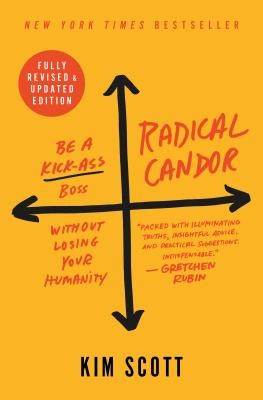
by Kim Scott
2017 · 336 pages · Summary updated 24 October 2026
Kim Scott's guide to being a good boss: care personally and challenge directly. Built on her years at Google and Apple. For managers who avoid hard conversations or deliver them badly.
A good boss does two things at once: care personally about each person and challenge directly when their work falls short. Scott calls the combination Radical Candor. Drop the care and you get Obnoxious Aggression. Drop the challenge and you get Ruinous Empathy, the most common failure, which Scott learned when she let a likable employee named Bob fail for ten months and then had to fire him. Drop both and you get Manipulative Insincerity. The book covers how to ask for criticism before you give it, how to manage rock stars and superstars differently, how to drive results through a cycle of listening, debating and deciding, and which meetings and routines make all of this a habit.
Scott's framework is a grid with two axes. Care personally means treating each person as a human with a life beyond work. Challenge directly means saying clearly when work is not good enough or a decision is wrong. Doing both is Radical Candor. Sheryl Sandberg modeled it when she told Scott that saying um every third word made her sound stupid, after first offering a speech coach. The blunt line worked because the care was already visible. Scott compares it to telling a stranger his fly is down: brief awkwardness that saves lasting harm.
Scott hired a likable man she calls Bob at her startup Juice Software. His work was sloppy. She said nothing because she did not want to hurt him. After ten months the team told her they were covering for Bob and some planned to leave, and she fired him. Bob asked why nobody had told him. Caring without challenging felt kind and was neglect. Scott argues most managers live in this quadrant. Obnoxious Aggression, challenge without care, is unpleasant but at least tells people where they stand. Manipulative Insincerity, neither care nor challenge, is office politics.
Guidance flows better once the boss has shown they can take it. Scott's go-to question is whether there is anything she could do or stop doing that would make it easier to work with her. After asking, she counts to six in silence, because people will try to say everything is fine. She listens to understand, not to defend, and rewards the criticism by acting on it or explaining why not. Managers who do this earn the right to criticize, and their teams learn that candor is safe.
Scott's rules for guidance: give it immediately, in two-minute conversations rather than saved for reviews; in person when possible; praise in public and criticize in private; describe the situation, the behavior and its impact rather than personality; and stay humble, because you may be wrong. "Great job" teaches nothing; saying what was good and why lets the person repeat it. "That report was sloppy" is about the work; "you are sloppy" is an attack that triggers defense instead of change.
Rock stars are excellent at their current job, love it and do not want promotion. They give the team stability. Superstars are on a steep growth path, want new challenges and leave if they stop growing. Managers who treat ambition as the only mark of talent promote rock stars into jobs they hate and bore superstars until they quit. Scott learned the distinction at Apple, where an engineer who had turned down promotions for years was valued rather than judged. She recommends a yearly growth management review, since people move between modes as their lives change.
Scott rejects the boss who decides alone. Her cycle has seven steps: listen, clarify, debate, decide, persuade, execute and learn. Listening comes first, whether quiet like Jony Ive or loud like Eric Schmidt. New ideas come out ugly, so clarify them before debate. Keep debate meetings separate from decision meetings so people argue the idea rather than fight for a verdict. Push decisions to the person closest to the facts. Persuade with credibility, emotion and logic. Do real work alongside the team. Then review results honestly and adjust without whiplash.
Scott borrows a three-conversation sequence from Russ Laraway, who used it at Google. The first conversation asks for the person's life story from early childhood, to learn what has motivated their choices. The second asks about their dreams for the peak of their career, in several versions. The third builds an 18-month plan that moves them toward those dreams, including skills to learn and roles to try. The conversations give managers a basis for growth plans that fit the person rather than the org chart.
The toolkit section turns the framework into a calendar. One-on-ones belong to the employee, who sets the agenda. A weekly staff meeting is for learning and clarifying, not status. Managers block think time. Big debate meetings and big decision meetings are separate. All-hands keep everyone informed, meeting-free zones protect real work, a visible board shows who is doing what, and walking around shows how the work feels. Hiring uses diverse panels, and firing happens sooner and with more care for dignity than most managers manage.
Kim Scott ran AdSense, YouTube and DoubleClick online sales and operations at Google, taught a management course at Apple University, and later coached the CEOs of Dropbox, Twitter and Qualtrics. She opens with a failure of her own. At Juice Software, a startup she co-founded, she hired a man she calls Bob. Everyone liked him. His work was sloppy, and Scott said nothing. She told herself he was having a rough patch and did not want to hurt his feelings. Ten months later the rest of the team told her they were covering for Bob and that some of them planned to leave. She fired him. Bob asked why nobody had told him.
Scott draws two lessons. Her silence was not kindness; it cost Bob his job and his chance to improve, and it cost the team months of extra work. And the problem was not that she did not care. It was that caring without challenging is a form of neglect.
The book's framework is a two-by-two grid. The vertical axis is care personally: treating each person as a human being with a life beyond work, not as a resource. The horizontal axis is challenge directly: saying clearly when work is not good enough, when someone is going to miss a target, or when a decision is wrong. The quadrants:
Her favorite example of Radical Candor comes from Sheryl Sandberg at Google. After Scott presented to Google's founders, Sandberg walked her back to her office and said she had said "um" a lot and offered a speech coach. Scott waved it off. Sandberg then said that saying um every third word made her sound stupid. Scott describes this as the kindest thing anyone had done for her career, because the blunt line finally made her listen, and Sandberg had already shown she cared by offering help.
A simpler illustration: a stranger walks out of a restroom with his fly down. Most people say nothing. Telling him is slightly awkward for both of you and saves him from an hour of embarrassment. Radical Candor is the fly down conversation, applied to work.
Scott calls feedback guidance and breaks it into praise and criticism. Her rules for both:
She also notes a trap for women managers, which she calls the abrasive trap: women who challenge directly are more often labeled aggressive, so they drift toward Ruinous Empathy. Her answer is not to stop challenging but to be aware of the bias and keep caring visible.
Most managers treat ambition as the only sign of a good employee. Scott separates two kinds of high performers. Rock stars are on a gradual growth trajectory. They are excellent at their current job, love it and do not want a promotion or a bigger team. They are the rock of the team, a source of stability. Superstars are on a steep growth trajectory. They want new challenges, learn fast and will leave if they stop growing.
Both are essential, and managers damage both when they confuse them. Promote a rock star into management and you lose a great engineer and gain an unhappy manager. Keep a superstar in the same role for two years and they leave. Scott learned this at Apple, where a manager told her that one of the best engineers on his team had turned down promotions for years and was content, and the company valued that rather than treating it as a lack of drive. Each year she suggests a growth management review: name who is in each mode this year, which can change with life events, and set plans that match.
For low performers she distinguishes people with poor results in the wrong role from people who do not want to improve. The first group needs a different job. The second needs a clear conversation and, if nothing changes, a quick, humane exit.
Scott rejects the boss who decides alone and tells people what to do. Her alternative is a cycle she calls the Get Stuff Done wheel, with seven steps:
Radical Candor depends on relationships, and Scott devotes a chapter to them. Stay centered: a manager who is exhausted and resentful cannot care personally, so protect sleep, exercise and whatever keeps you sane. Be a boss, not a dictator: give people freedom at work. Do not force socializing; mandatory happy hours do not build trust, and respecting boundaries does. Build trust through small consistent acts, and let people bring their whole selves to work, including the parts that are not about work.
The second half of the book is a toolkit. For one-on-ones, the employee sets the agenda and the manager listens; the meeting exists for the employee's issues, not status updates. For career growth, Scott borrows Russ Laraway's three career conversations from his time at Google: first the person's life story, from kindergarten on, to learn what motivates them; second their dreams for the peak of their career; third an 18-month plan that moves them toward those dreams.
For team rhythm she recommends a weekly staff meeting to learn, listen and clarify, a block of think time for the manager, separate big debate and big decision meetings, regular all-hands, meeting-free zones for real work, a visible board that shows who is doing what, and walking around to see how the work feels. Each tool exists to make Radical Candor a habit rather than an event.
She also covers hiring, with diverse interview panels and decisions based on more than gut feel, and firing, which she says managers delay too long and then handle with too little care. Her advice is to act sooner and to think hard about the person's dignity on the way out.
The most common criticism is that readers use the phrase as cover for Obnoxious Aggression, which Scott addresses in the 2019 revised edition. Reviewers also note that the examples come almost entirely from Silicon Valley, and that direct challenge lands differently in cultures and companies where it is punished. Several point out that women and people of color face more risk when they speak candidly, which the book names but does not fully solve.
Read it if you manage people and either avoid hard conversations or deliver them badly. New managers get a complete set of routines. Experienced managers get a clear diagnosis of where their feedback goes wrong.
12 cards
Question 1 of 5
Which quadrant describes a manager who cares about people but never criticizes their work?
Gary Keller and Jay Papasan argue that extraordinary results come from narrowing your focus to one thing at a time. For anyone whose to-do list keeps growing while the important work stalls.
Patrick Lencioni's leadership fable about a new CEO who rebuilds a failing executive team, followed by his five-level model of why teams fail. For managers and anyone who sits on a leadership team.

Sun Tzu's 13 short chapters on strategy from ancient China: win without fighting, know yourself and your enemy, and shape the ground before the battle. For readers in business, politics or any contest.
Simon Sinek's Golden Circle: leaders and companies that inspire start with why they exist, not what they sell. For founders, managers and anyone who needs people to follow an idea.
More in Business and startups →More in Communication and persuasion →
New books, occasionally