
Emily Brontë's 1847 novel about Heathcliff, Catherine Earnshaw and two families on the Yorkshire moors, told across two generations. For readers who want the plot, the characters and the ideas behind a famous story of love and revenge.
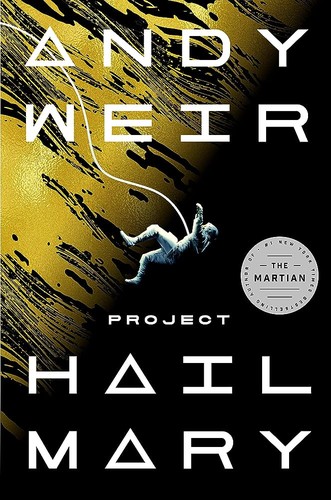
by Andy Weir
2021 · 496 pages · Summary updated 24 October 2026
Andy Weir's science fiction novel about Ryland Grace, a man who wakes alone on a spaceship with no memory, tasked with saving the sun. For readers who want problem-solving, hard science and an alien friendship.
Ryland Grace wakes in a small room with two corpses and no memory of who he is. He works out that he is on a spaceship, light-years from Earth. Memories return in pieces. The sun is dimming because of Astrophage, a microbe that feeds on starlight. Earth has decades before famine. The only nearby star that is not dimming is Tau Ceti, and Grace was sent there to find out why. At Tau Ceti he meets Rocky, an alien engineer whose own star has the same disease. The two learn to talk, then to work, and together they hunt for a cure. Weir's argument is that science is a method anyone can follow, and that the best problem-solving is shared.
Grace wakes with no name and no memory. He measures gravity with a dropped object and a count, works out that he is in a spinning ship, and builds from there. Weir's reasoning is that the scientific method needs observation, a guess and a test, not a lab. The example runs through the book: Grace dates the corpses, finds the ship's spin rate and later decodes Rocky's language with the same loop of guess, test and revise.
Grace and Rocky have no common language, senses or chemistry. They start with what both can verify: numbers, the periodic table, the shape of the ships. Weir argues that any two intelligent beings can build a language from the physical world upward. The example is Grace playing musical chords back to Rocky and matching each to an object, until the two can discuss relativity through a clear wall.
Astrophage stores energy at a density nothing on Earth can match. Weir reasons that this one fact changes everything: it makes an interstellar ship possible, but it also means the same microbe that dims the sun powers the mission to save it. The example is the Hail Mary itself, which could not exist without the disease it fights. The idea is that a threat and a resource can be the same thing.
Eva Stratt has unlimited authority and uses it. She seizes an aircraft carrier, warms the planet by breeding Astrophage, and tests coma drugs on people who did not volunteer. Weir does not excuse her, but he shows her logic: a thirty-year deadline leaves no room for consent in every case. The example is her reply when challenged, that she expects to be tried for what she did once the crisis is over.
Taumoeba dies in nitrogen, and both home planets have nitrogen. Grace and Rocky do not engineer a fix. They breed billions of Taumoeba under slowly rising nitrogen and keep the survivors. Weir's reasoning is that selection does the design work when generations are short. The example is the series of tanks at increasing nitrogen levels and the strain that finally survives at Earth's concentration.
Rocky and Grace meet with no weapons and no fear. Each needs the other, and each is as frightened as the other. Weir argues that two species facing the same problem have every reason to cooperate. The example is the way the two share failures: Rocky's crew died from radiation they did not know existed, and Grace's crew died from a coma drug that worked on him only by chance. Neither hides it.
Grace learns that he refused the mission and that Stratt drugged him and put him aboard. He was not the hero he had imagined. Then he chooses to use his return fuel to rescue Rocky, knowing it strands him forever. Weir's reasoning is that a past act of cowardice does not fix what a person is. The example is the final chapter, where Grace teaches on Erid and learns that the sun is bright again.
Project Hail Mary is Andy Weir's third novel, published in 2021. Like The Martian, it follows one person who uses science to survive in space. The difference is that the stakes are not one life but every life on Earth, and the main character is not alone for long.
The book opens with a man waking in a small room. A computer voice asks him math questions. Two robotic arms tend him. He cannot remember his name. Two other beds in the room hold corpses, long dead. He works out, from the pull on his body and the layout of the room, that he is in a spinning spacecraft. Slowly he recalls that he is Ryland Grace, a junior high school science teacher.
The novel runs on two timelines. The present follows Grace on the ship. The past returns as flashbacks whenever a memory surfaces. Weir uses the amnesia as a device: the reader learns the mission at the same pace Grace does.
In the flashbacks, astronomers notice that the sun is losing brightness. A faint arc of infrared light connects the sun and Venus. They call it the Petrova line, after the scientist who found it. A probe collects samples, and the samples are alive. The organism is a single-celled microbe that absorbs light, stores it as energy, and breeds on Venus using carbon dioxide. Scientists name it Astrophage. Its mass is so dense with energy that it is also the most powerful fuel ever found.
Grace enters the story because, years earlier, he wrote a paper arguing that life does not need water. The paper ended his academic career. He left research and became a teacher. A woman named Eva Stratt finds him anyway. Stratt runs the Petrova Taskforce, an international body with unlimited authority to stop the sun from dying. She has Grace study the samples because no one else will take the idea of a non-water-based organism seriously.
The math is bleak. The sun will lose enough light within about thirty years to trigger an ice age and mass famine. Every nearby star shows the same infection, except one. Tau Ceti, twelve light-years away, is bright and stable. Something there stops Astrophage. Stratt decides to send a ship to find out what.
The mission takes its name from the last-ditch pass in American football. The ship, the Hail Mary, burns Astrophage as fuel, which is the only way to reach another star in a human lifetime. A crew of three will travel in medically induced comas, because the trip takes years and the coma drugs are the only way to keep them alive. The ship cannot carry fuel for a return. It will send its findings back to Earth on four small automated probes, which the crew name after the Beatles: John, Paul, George and Ringo.
Stratt's taskforce breeds Astrophage in huge quantities, which warms the planet as a side effect. It tests coma survival on unwilling subjects. It takes an aircraft carrier for its work. Weir presents Stratt as a person who accepts any cost for the mission and knows that history will judge her.
The coma is the weak point. Tests show that most people die under the drugs, and only a small share of the population can survive them. Grace turns out to be one of them, which puts his name on the candidate list. The chosen science specialist and his backup both die in an accident during preparations. The only other person who knows the Astrophage research well enough to replace them is Grace.
In the present, Grace finds the ship's logs and the crew names: Commander Yáo and engineer Ilyukhina, both dead. He understands that he is the last person alive on the Hail Mary. He explores the ship deck by deck: a control room, a lab stocked with equipment he recognizes, a dormitory, and a hull full of Astrophage fuel. The computer gives him everything the mission planners thought a crew would need, except the memory of why he is there. He starts a routine, since routine is what a science teacher knows, and he keeps notes the way he would for a class.
When Grace arrives at Tau Ceti, another ship is already there. It is made of a material no human could make, and it is not from Earth. Its single occupant is an alien that Grace names Rocky.
Rocky is about the size of a large dog. He has five legs, a body of hard carapace, and no eyes. He senses the world by sound. He breathes ammonia at pressures and temperatures that would kill a human in seconds, so the two can never share a room. They build a tunnel between the ships with a clear wall and talk through it. Rocky speaks in chords of musical notes. Grace records them, builds a translation program, and the two develop a shared language. Rocky learns English words. Grace learns Rocky's grammar, in which a question is a single note at the end.
Rocky is an engineer from a planet orbiting the star 40 Eridani, which he calls Erid. His species also discovered Astrophage dimming their star and sent a crew to Tau Ceti. Everyone else aboard died, because Eridians had never left their planet and did not know about radiation. Rocky has been waiting alone for years. He can build almost anything from the material of his ship, which Grace calls xenonite, and he repairs the Hail Mary's failing systems as the story goes on.
The friendship is the heart of the book. The two trade science. Grace tells Rocky about relativity. Rocky tells Grace that Eridians sleep in a state so deep that they cannot be woken, and that they have no concept of sight. Their catchphrase, "fist my bump," comes from a mistranslated gesture.
Grace and Rocky find that one planet in the Tau Ceti system, which Grace names Adrian, has Astrophage in its atmosphere and something that eats it. They collect samples. The predator is a single-celled organism that hunts Astrophage. Grace names it Taumoeba.
Taumoeba is the cure. Release enough of it at a star's Petrova line and it will eat the infection. But both Earth and Erid have nitrogen in their atmospheres, and nitrogen kills Taumoeba. Grace and Rocky breed generation after generation under rising nitrogen levels until a strain survives. The work takes weeks and nearly fails several times, including a leak that lets Taumoeba loose in the Hail Mary. The escaped Taumoeba reach the fuel tanks and begin to eat the ship's Astrophage. Grace and Rocky have to find the breach, seal it and work out how much fuel is left before the ship can make any trip at all. Rocky rebuilds parts of the Hail Mary in xenonite as they go.
The trip to Adrian also nearly kills Grace. He takes the Hail Mary into the planet's upper atmosphere to collect samples, and the heat and drag push the ship past its limits. Rocky, who stays behind on his own ship, talks him through the recovery.
Meanwhile, Grace's memories reach the day he left Earth. They are not what he expected.
This section reveals the ending.
The last flashback shows that Grace refused the mission. He was afraid to die. Stratt sedated him and put him on the ship against his will, because the coma drugs would wipe his memory of the refusal. The brave scientist he had imagined himself to be was never real. Grace has to decide who he is now that he knows.
The two ships part. Grace loads the nitrogen-resistant Taumoeba into the four probes and sends them toward Earth. Rocky heads home to Erid with his own supply. Then Grace discovers that the Taumoeba can eat through xenonite. Rocky's ship is fueled by Astrophage stored in xenonite tanks. The Taumoeba will eat Rocky's fuel, and his ship will drift dead in space.
Grace has enough fuel to return to Earth. He uses it instead to chase Rocky down. He rescues him, and they travel together to Erid. Grace will never see Earth again. He will eat only the food on the ship until Rocky's people can learn to feed him.
The final chapter is set years later. Grace lives in a habitat built for him on Erid. He teaches Eridian children science, which is what he always wanted to do. The Eridians have built a telescope for him. One day it shows that the sun is back to full brightness. The Taumoeba reached Earth and worked. Grace's class is waiting, and he goes to teach it.
Reviewers often say the book repeats the formula of The Martian: a cheerful narrator solves one engineering problem after another and explains each one. Some find the voice similar to Mark Watney's and the jokes repetitive. The human characters on Earth, Stratt included, are thin, and the flashbacks lean on coincidence. Several reviewers also note that every crisis has a solution that arrives on time. Almost all of them praise Rocky, and many say the friendship carries the book.
Read it if you liked The Martian or want science fiction where the science is explained and the problems are solved on the page. It also works for readers who want a story about friendship across a gap that looks impossible.
12 cards
Question 1 of 5
What does Grace first use to work out that he is on a spinning spacecraft?
Grace learns that he refused the mission and was drugged and put aboard by Eva Stratt. He sends the cure, nitrogen-resistant Taumoeba, to Earth on four probes. Then he discovers Taumoeba will destroy Rocky's fuel, so he spends his own return fuel to rescue Rocky and goes with him to Erid. Years later he teaches Eridian children and sees through a telescope that the sun has recovered.
Emily Brontë's 1847 novel about Heathcliff, Catherine Earnshaw and two families on the Yorkshire moors, told across two generations. For readers who want the plot, the characters and the ideas behind a famous story of love and revenge.

Harper Lee's novel about Scout Finch, her brother Jem, and their father Atticus, who defends a Black man falsely accused of rape in 1930s Alabama. For students and readers who want the plot, the themes and the ending in plain words.

Chinua Achebe's novel about Okonkwo, an Igbo leader whose village is undone by his own rigidity and the arrival of British missionaries. For readers who want the colonial encounter told from the African side.
Homer's ancient Greek epic about Odysseus's ten-year journey home from Troy to Ithaca, and his son Telemachus's search for him. For readers who want the plot, the characters and the ideas, book by book.
New books, occasionally