
Wonder by R. J. Palacio is a novel about August Pullman, a ten-year-old boy with a facial difference who goes to school for the first time in fifth grade. For readers who want the plot, the narrators and the book's lesson on kindness.
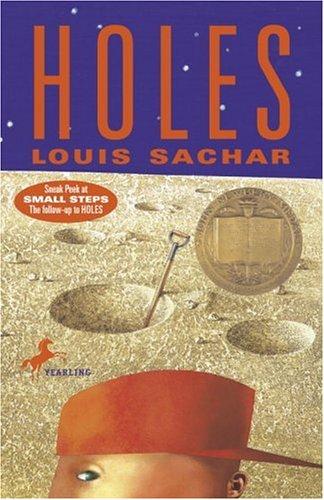
by Louis Sachar
1998 · 233 pages · Summary updated 24 October 2026
Holes by Louis Sachar is a novel about Stanley Yelnats, a boy sent to a desert camp to dig holes for a crime he did not commit, and the family curse that ties his story to the past. For readers who want the plot, the characters and the themes.
Stanley Yelnats is an unlucky, overweight boy from a family that blames everything on a curse. A judge sends him to Camp Green Lake, a dry lakebed in Texas, for stealing a famous baseball player's sneakers. He did not steal them. At camp, every boy digs one hole a day, five feet deep and five feet wide, to build character. Stanley soon suspects the Warden is looking for something. Sachar tells three stories at once: Stanley at camp, his great-great-grandfather in Latvia, and an outlaw schoolteacher in the town of Green Lake a hundred years earlier. The stories fit together like pieces of a puzzle, and the book argues that friendship and kept promises can undo old wrongs.
Sachar tells Stanley's camp story alongside two older stories: Elya Yelnats in Latvia and Kate Barlow in Green Lake a century earlier. At first they seem unrelated. Slowly, details cross from one to the other: the spiced peaches, the onions, the lullaby, a pair of initials. The structure rewards attention. The example is the gold tube Stanley finds in his hole, engraved with the letters KB, which tells him the Warden is hunting for something specific.
Stanley is innocent, but no one believes him, and the court sends him to a camp built for profit and cruelty. Sachar shows adults who use rules to hide what they want. The Warden calls the digging character building. The counselors write off the boys. The example is the moment the Warden orders Zero's records erased: in a system with no oversight, a missing boy can simply cease to exist.
The town turns on Sam, a Black onion seller, because he kissed Katherine Barlow, a white woman. A mob burns the schoolhouse and kills him on the lake. Sachar places the town's ruin right after this crime: the lake dries up and the rain stops. The book treats the drought as the long cost of a community's violence. The example is Kate's change from a kind teacher into the outlaw Kissin' Kate.
The Yelnats family blames everything on a curse, but the curse comes from one broken promise: Elya never carried Madame Zeroni up the mountain. Sachar suggests that bad luck is often the result of choices left undone. Stanley changes his life not by waiting for luck but by doing what his ancestor failed to do. The example is Stanley's choice to walk into the desert after Zero when everyone else has given him up.
Stanley and Zero start with a bargain. Zero digs part of Stanley's hole, and Stanley teaches Zero to read. Over time, the deal becomes a friendship. Each boy gives what he has. Sachar shows that respect grows from small, regular acts. The example is the reading lessons: Zero, whom everyone calls stupid, learns quickly, and Stanley, whom everyone calls a loser, turns out to be a patient teacher.
At camp, every boy has a nickname. Zero is named for what others think he is worth. Stanley is called the Caveman. Mr. Pendanski tells Zero a shovel is all he is good for. Sachar shows how these labels trap people and how wrong they are. The example is Zero himself: everyone calls him stupid, yet he is quick at math, learns to read fast and turns out to be loyal and brave.
Zero is a descendant of Madame Zeroni, and he is the boy who took the sneakers that fell on Stanley. When Stanley carries him up the mountain, he keeps Elya's old promise to a Zeroni, and the curse lifts. Sachar uses these links to show that the past keeps shaping the present until someone repairs it. The rain falling on Green Lake at the end marks the repair of two old wrongs.
“There is no lake at Camp Green Lake.”
Holes by Louis Sachar was published in 1998. It won the Newbery Medal and the National Book Award for Young People's Literature, and it became a Disney film in 2003. It is a middle-grade novel, but adults read it too, because its plot is a precise puzzle. Three stories from three different centuries run side by side, and small details in one turn out to matter in another.
The book opens with a flat statement: there is no lake at Camp Green Lake. There was once a large lake and a town. Now there is a dry, flat wasteland, with a few buildings, a shower stall, and holes in every direction. The camp is a juvenile detention center for boys. The counselors say that if you make a bad boy dig a hole every day in the hot sun, he will turn into a good boy.
The hero is Stanley Yelnats IV. His name is a palindrome: Yelnats is Stanley spelled backward. He is overweight, has no friends, and is bullied at school. His father is an inventor who never succeeds, and he is trying to find a way to recycle old sneakers. His family blames their bad luck on a curse put on Stanley's "no-good-dirty-rotten-pig-stealing-great-great-grandfather." They laugh about it, but they also believe it.
One day a pair of old sneakers falls from the sky and hits Stanley on the head as he walks home under a freeway overpass. He takes them home, thinking they might help his father's experiments. The police stop him. The shoes belong to Clyde "Sweet Feet" Livingston, a star baseball player, who donated them to a homeless shelter for a charity auction. They were stolen from the shelter.
No one believes Stanley's story. The judge gives him a choice: jail, or Camp Green Lake. Stanley has never been to camp, and his family is poor, so he chooses the camp. He rides a bus for eight hours into the desert.
At camp, Mr. Sir checks him in. He eats sunflower seeds because he gave up smoking. He tells Stanley that this is not a Girl Scout camp, and that the only shade belongs to the Warden. The counselor Mr. Pendanski pretends to be kind, but he mocks the boys. Stanley joins Group D, in the tent called D Tent. The boys use nicknames: X-Ray, the leader, Armpit, Squid, Zigzag, Magnet, and Zero, a small, silent boy whom everyone thinks is stupid.
Every day the boys wake before dawn and dig. Each hole must be five feet deep and five feet across, measured with the shovel. The rules are strict and the dangers are real. Rattlesnakes and scorpions live in the dirt. Worst of all are yellow-spotted lizards, whose bite kills. A water truck brings water twice a day.
The counselors say that if a boy finds anything interesting, he must report it, and the Warden may give him the day off. Stanley's first holes are slow and painful, and his hands blister. Over weeks, his body changes. He gets stronger and loses weight. He also learns the rules of the group. X-Ray is first in every line, and a new boy is last.
In his hole, Stanley finds a small gold tube with the letters KB engraved on the bottom. He gives it to X-Ray, who reports it as his own find so he can get the day off. The Warden is suddenly excited. She drives out, stands over the hole, and orders the boys to dig there with extra care. Stanley realizes the boys are not digging to build character. The Warden is searching for something.
The Warden is a woman with red hair and freckles. She paints her nails with a polish made from rattlesnake venom and rubbed with dirt, and she scratches Mr. Sir across the face with it when he lies to her. She is the most frightening adult in the book.
Between the chapters set at camp, Sachar tells two older stories.
The first is about Elya Yelnats, Stanley's great-great-grandfather, in Latvia. Elya loves a pretty, empty-headed girl named Myra Menke. Her father will give her to the man with the fattest pig. Elya asks for help from Madame Zeroni, an Egyptian fortune-teller with one leg. She gives him a piglet and tells him to carry it up a mountain every day to drink from a stream while he sings a lullaby to it. In return, he must carry her up the same mountain, to drink from the stream and hear the song. If he fails, his family will be cursed forever. Elya does the work, but Myra cannot choose between him and the other suitor. He gives up on her, leaves for America, and forgets his promise to Madame Zeroni. The curse begins.
The second story is about the town of Green Lake, 110 years earlier. The lake is full and the town is green. Katherine Barlow, the schoolteacher, makes famous spiced peaches. She falls in love with Sam, a Black man who sells onions and fixes things and who claims his onions cure every illness. They kiss. In that town and at that time, a Black man cannot kiss a white woman. A mob led by Trout Walker, a rich man Katherine rejected, burns the schoolhouse and shoots Sam on the lake. Three days later Katherine kills the sheriff. She becomes the outlaw Kissin' Kate Barlow, who robs people across the West and leaves a lipstick kiss on the men she kills. No rain falls on Green Lake again.
One of the people Kate robbed was Stanley's great-grandfather, the first Stanley Yelnats, who made money in the stock market. She left him stranded in the desert. He survived, he said, by finding refuge on "God's thumb."
At camp, Stanley's mother writes to him and he writes back, making up stories about how much fun camp is. Zero watches him write. Zero cannot read and asks Stanley to teach him. Stanley is too tired after digging, so Zero offers a trade: he will dig part of Stanley's hole every day, and Stanley will give him reading lessons. The other boys resent Stanley for it. They call him the Caveman, a nickname that started as a joke and becomes a sign of respect, then of envy.
A fight starts with Zigzag. Mr. Pendanski mocks Zero in front of everyone. He hands Zero a shovel and says it is all he will ever be good for. Zero swings the shovel and hits Mr. Pendanski in the face. Then he walks off into the desert with no water.
The Warden decides to pretend Zero never existed. She orders his files deleted. Without water, he will die, and no one will come looking for a boy whose records say he was never there. Stanley tries to dig and cannot. He steals the water truck, crashes it into a hole, and walks into the desert after Zero. The rest of the story, which ties all three timelines together, belongs in the spoiler sections below.
This section reveals the major twists.
Stanley finds Zero under an overturned boat in the desert, a boat named Mary Lou, which was Sam's onion boat. Zero has survived on jars of 100-year-old spiced peaches, which he calls sploosh. Kate Barlow made them. Zero is very sick. Stanley sees a rock formation shaped like a fist with the thumb up and remembers his great-grandfather's "God's thumb."
The two boys walk toward the mountain. When Zero is too sick to walk, Stanley carries him up the slope on his back. At the top they find a spring and a field of wild onions, Sam's onions. They eat onions and drink water for days, and Zero recovers. Stanley sings his family's lullaby, and the curse begins to lift: he has carried a Zeroni up a mountain to drink from a stream. Zero tells Stanley the truth about the sneakers. He is the one who took them from the homeless shelter. He was living on the streets and needed shoes, so he took them from a display. When people made a fuss about the theft, he got rid of them. They are the shoes that fell from the overpass onto Stanley.
Zero's real name is Hector Zeroni. He is Madame Zeroni's great-great-grandson.
The Warden is a descendant of Trout Walker and his wife, Linda Miller. Her family has owned the dry lake since the town died. They have been digging for Kissin' Kate's buried treasure for generations. Before Kate died from a lizard bite, she told Trout Walker to start digging, and they never found it. The boys' holes were never about character. They are a free treasure hunt.
This section reveals the ending.
Stanley believes the gold tube came from the treasure. He and Zero return to camp at night and dig in the hole where he found it. They find a metal suitcase. Then they discover the hole is full of yellow-spotted lizards. They sit still all night. The lizards do not bite. The boys have been eating onions for days, and the lizards do not like onion blood, the same reason Sam was safe on the lake.
At dawn the Warden arrives and waits for the lizards to kill the boys so she can take the suitcase. Instead, Stanley's lawyer, Ms. Morengo, arrives with the Texas Attorney General. Stanley has been proven innocent. The Warden claims Stanley stole the suitcase, but the name on it is Stanley Yelnats. It belonged to the first Stanley, the man Kate robbed. The suitcase is legally his.
The Attorney General closes Camp Green Lake. The Warden loses the land she has dug for her whole life. Stanley's father finally invents something that works: a cure for foot odor, which he names Sploosh. The stock certificates and jewels in the suitcase make both families comfortable. Zero uses his share to hire detectives, who find his mother. In the last scene, the two families are together, and Zero's mother sings a version of the lullaby. For the first time in over a hundred years, it rains on Green Lake.
Sachar ends by telling readers that they will have to fill in some holes themselves, such as what happens to the other boys.
Read it if you want a short, funny novel with a tightly built plot, or if you are studying it and need the timelines in order. It suits readers aged ten and up, and adults who enjoy a mystery where every small detail pays off.
12 cards
Question 1 of 5
Why is Stanley Yelnats sent to Camp Green Lake?
Stanley and Zero dig up a suitcase that belonged to Stanley's great-grandfather. The lizards in the hole do not bite them because they have eaten onions. Stanley's lawyer arrives and proves him innocent. The camp closes, the families share the treasure, Zero finds his mother, the curse lifts and it rains on Green Lake for the first time in over a hundred years.
The counselors say digging builds character and turns bad boys into good ones. The real reason is that the Warden is searching for the buried treasure of the outlaw Kissin' Kate Barlow. Her family has owned the land and hunted for it for generations, and the boys' holes give her free labor.
Wonder by R. J. Palacio is a novel about August Pullman, a ten-year-old boy with a facial difference who goes to school for the first time in fifth grade. For readers who want the plot, the narrators and the book's lesson on kindness.

Ugly Love is Colleen Hoover's romance about Tate Collins, a nursing student who agrees to a no-strings affair with a guarded airline pilot, Miles Archer, whose past is a closed door. For readers who want a steamy, emotional love story with a heartbreaking backstory.
Zora Neale Hurston's novel about Janie Crawford, a Black woman in early 1900s Florida who moves through three marriages in search of real love and her own voice. For readers who want the plot, the themes and the meaning of the title.

The Wife Upstairs is Rachel Hawkins's 2021 thriller that retells Jane Eyre in a wealthy Alabama suburb, where a broke dog walker falls for a widower whose wife vanished on a lake. For readers who like twisty domestic suspense.
New books, occasionally