
Wonder by R. J. Palacio is a novel about August Pullman, a ten-year-old boy with a facial difference who goes to school for the first time in fifth grade. For readers who want the plot, the narrators and the book's lesson on kindness.
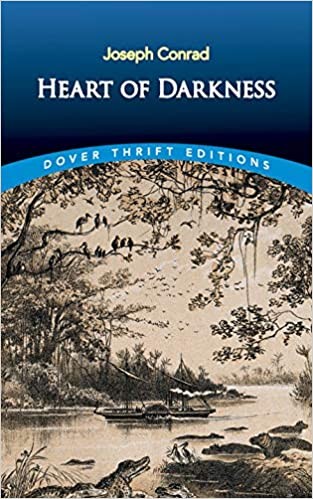
1899 · 72 pages · Summary updated 24 October 2026
Heart of Darkness is Joseph Conrad's novella about Marlow, a steamboat captain who travels up the Congo River for a Belgian ivory company and finds the agent Kurtz. For readers who want the plot, the main ideas and the debate around the book.
On a boat on the Thames at dusk, the sailor Marlow tells his friends about a journey he once made up the Congo River for a European ivory company. Along the way he sees forced labor, waste, violence and the greed of the company's agents, who call their work civilization. Everyone talks about Kurtz, the company's most successful agent, who is said to be brilliant and idealistic. When Marlow reaches him deep in the interior, he finds a man who has set himself up as a god. Conrad's short book asks what happens to people when the restraints of society fall away, and what empire really is.
Marlow's aunt talks about weaning the ignorant millions from their horrid ways. The Company's agents talk of trade and progress. What Marlow sees is a chain gang, a pointless railway, men left to die in a grove, and agents who care only for ivory and promotion. Conrad shows the gap between the language of empire and its practice. The noble words make the theft easier to accept for the people back home.
Marlow is surprised that his hungry crew does not eat the pilgrims. He calls their self-control restraint, and it impresses him. Kurtz has none left. Alone, with no police, neighbors or public opinion to check him, he takes what he wants and lets himself be worshipped. Conrad suggests that much of what passes for goodness in Europe depends on outside pressure. Remove it, and a person learns what is really inside.
The story begins with Marlow saying that London, too, has been one of the dark places of the earth, when Romans conquered it. It ends with the Thames seeming to flow into an immense darkness. The darkness of the title is not a place. It is the cruelty and emptiness that the Company's men bring with them and that Kurtz finds in himself. Conrad turns the European idea of a dark continent back on Europe.
Marlow is no hero, but he holds on to his duty. He repairs the steamer, waits for rivets, watches the river for snags and keeps the boat afloat. He says that work gives him a chance to find himself. The accountant's clean collar and tidy books show the same impulse in a darker way: order maintained in the middle of horror. Conrad suggests that daily practical work protects people from the madness around them.
Kurtz arrived as a man of ideas. He paints, writes, speaks beautifully, and wrote a report about bringing light to Africa. He ended up raiding villages for ivory and mounting heads on poles. The postscript to his report, exterminate all the brutes, shows the turn. Conrad warns that grand ideals without limits can justify anything, and that the most eloquent man may fall the furthest.
In the novella, African characters almost never speak. The helmsman dies without a word. The woman at the riverbank only gestures. The few words they are given are short and in broken English, such as the announcement of Kurtz's death. Chinua Achebe argued that this makes Africa a backdrop for a European's story. Reading the book today means noticing whose experience it records and whose it leaves out.
Marlow says he hates lies. Yet when Kurtz's fiancée asks for his last words, he tells her it was her name, not the horror. He protects her belief in Kurtz and, perhaps, the belief of Europe in its own mission. Conrad leaves it open whether this is mercy or cowardice. The ending shows how comforting stories survive because the people who know the truth choose not to tell it.
“"And this also," said Marlow suddenly, "has been one of the dark places of the earth."”
Heart of Darkness is a short novel by Joseph Conrad, first published in three parts in Blackwood's Magazine in 1899 and as a book in 1902. Conrad was born in 1857 to Polish parents in what is now Ukraine, became a sailor in the French and British merchant navies, and wrote in English, his third language. In 1890 he took a job as a steamboat officer on the Congo River, then a private colony of King Leopold II of Belgium. He fell ill and came back changed. The novella draws on that trip.
The book has a frame. An unnamed narrator sits with four friends on a yacht, the Nellie, at the mouth of the Thames as the sun goes down. One of them is Charlie Marlow, a sailor who also narrates other Conrad stories. Marlow looks at London and says that this, too, has been one of the dark places of the earth. He means that Romans once came to Britain as conquerors among people they saw as savages. Then he tells the story of his trip to Africa. Almost the whole book is his voice, reported by the narrator.
The novella never names the Congo, Belgium or King Leopold. It speaks of a river shaped like a snake, a city that makes Marlow think of a whited sepulchre, and the Company. But readers in 1899 knew what was meant. Leopold's Congo Free State was already notorious for forced labor and violence in the collection of ivory and rubber.
The book has three sections. It is short, often under 100 pages, but dense. Marlow's way of speaking is circling and full of hints. He often describes a feeling before he explains what caused it.
As a boy, Marlow loved the blank spaces on maps. One of them, the large river in Africa, still draws him. Through an aunt with connections, he gets a job as captain of a river steamer for a Continental trading company. The last captain was killed in a quarrel over two black hens.
At the Company offices in the European city, two women knit black wool at the door, like guards to another world. A doctor measures Marlow's skull and asks whether there is madness in his family. His aunt talks about weaning the ignorant millions from their horrid ways. Marlow notes that the Company is run for profit.
On the voyage along the coast, he sees a French warship firing shells into the forest at an enemy no one can see. At the Outer Station, he finds a railway being built with no purpose. A cliff is being blasted that is not in the way. A chain gang of African men, iron collars on their necks, walks past. In a grove of trees he finds dying workers who have been worked until they are useless and left in the shade to die.
Then he meets the Company's chief accountant, who wears a starched white collar and a perfect suit and keeps his books in order in the middle of this. The accountant is the first to mention Mr. Kurtz, a first-class agent in charge of a trading post deep in the interior, who sends in as much ivory as all the others together. He will go far, the accountant says.
Marlow walks 200 miles with a caravan to the Central Station. He finds his steamer sunk at the bottom of the river. The manager, a man who inspires only unease, says it will take months to repair. Marlow suspects that the wreck was arranged to delay any help to Kurtz, whom the manager sees as a rival.
The agents at the station, whom Marlow calls pilgrims because they carry long staves, do nothing but intrigue and wait for promotion. One of them, a brickmaker who makes no bricks, tries to learn what Marlow knows about Kurtz. A shed full of trade goods burns, and an African worker is beaten for it. Marlow waits for months for rivets to repair the boat. A group calling itself the Eldorado Exploring Expedition arrives, looking only to tear treasure from the land, and vanishes into the forest.
Marlow overhears the manager and his uncle talking about Kurtz: he is ill, he came back partway down the river once and then turned back alone to his station. They hope the climate will finish him.
At last the steamer is repaired. Marlow sets off with the manager, a few pilgrims and a crew of African men, among them a helmsman and a group Marlow calls cannibals. The journey takes about two months. Marlow describes the river as travel back to the earliest beginnings of the world. The forest is a wall. Drums sound at night.
Near the end, they find a hut with a pile of firewood and a note saying to hurry and approach with caution. Inside is an old book on seamanship with notes in the margins in what Marlow thinks is a code. It turns out to be Russian.
A thick white fog stops them a short distance below Kurtz's station. They hear a great cry from the shore. When the fog lifts, the boat is attacked with arrows. Marlow blows the steam whistle, and the attackers scatter. The helmsman is killed by a spear. Marlow throws his bloody shoes overboard and later pushes the helmsman's body into the river so the crew will not eat it. He feels a strange grief for him.
At the Inner Station, a young Russian in a suit covered in colored patches greets them. He is a wandering sailor who has been with Kurtz for months and worships him. He says that Kurtz has enlarged his mind. He also lets slip that Kurtz led raids for ivory, ordered the attack on the steamer, and made the local people treat him as a god.
Through his binoculars, Marlow sees round knobs on the posts around Kurtz's house. They are human heads, dried, facing the house.
Marlow has read a report Kurtz wrote for the International Society for the Suppression of Savage Customs. It is seventeen pages of fine idealistic prose about bringing light to Africa. At the end, in a shaky hand, Kurtz has added: exterminate all the brutes.
This section reveals the ending.
Kurtz is carried out on a stretcher, thin as a skeleton and very ill. A crowd of armed men stands silently around him. A tall African woman, richly dressed, walks to the river's edge and raises her arms toward the boat. The manager is pleased: Kurtz's methods, he says, were unsound, and his illness gives the Company a reason to take over his ivory.
That night, Kurtz crawls away from the boat toward the fires where his followers are dancing. Marlow goes after him alone and persuades him to come back. He feels that Kurtz's soul has gone mad with no restraint left. In the morning, as the steamer leaves, the crowd gathers on the shore, and the woman cries out. Marlow sounds the whistle, and the pilgrims fire into the crowd for fun.
On the way down the river, Kurtz talks without end about his ideas, his fiancée and his plans. He gives Marlow a packet of papers and a photograph. One night, Marlow sees a look of terror on his face. Kurtz cries out, in a whisper, the horror, the horror. Soon after, the manager's servant puts his head into the dining room and announces in scorn that Kurtz is dead. The pilgrims bury him in a muddy hole.
Marlow falls ill and nearly dies. Back in Europe, he gives the report, minus its postscript, to a Company man. About a year later he visits Kurtz's Intended, his fiancée, who is still in mourning. She believes in Kurtz's goodness. She asks for his last words. Marlow cannot tell her. He lies and says the last word Kurtz spoke was her name. She weeps with relief. Marlow, who has said that he hates lies, says it would have been too dark to tell her the truth.
Marlow stops talking. The narrator looks out at the Thames and sees that the river seems to lead into the heart of an immense darkness.
In 1975, the Nigerian novelist Chinua Achebe gave a lecture, An Image of Africa, that changed how the book is read. He argued that Conrad uses Africa only as a backdrop for a European's crisis, denies Africans speech and humanity, and was a racist, and that the novella should not be taught as a great work without that criticism. Many critics agree that the book shares the racial views of its time even as it attacks empire. Others argue that Marlow's narrow view is part of what Conrad shows. The debate is now part of studying the book. The novella's style, full of vague words like inscrutable and unspeakable, also divides readers. Francis Ford Coppola's film Apocalypse Now (1979) moves the story to the Vietnam War.
Read it if you want a short, demanding book about empire, greed and the darkness inside people who call themselves civilized, and the debate about how it treats Africa. It suits readers who like dense, atmospheric prose, and students who need the plot and the criticism together.
12 cards
Question 1 of 5
Where does Marlow tell his story?
Kurtz, gravely ill, dies on the steamer after crying out "The horror! The horror!" Marlow returns to Europe. A year later he visits Kurtz's fiancée, who asks for his last words. Marlow lies and says Kurtz spoke her name. The narrator then sees the Thames as leading into an immense darkness.
They are Kurtz's last words. Most readers take them as his final judgment on what he has done and seen: his own cruelty, the greed of the ivory trade, and the darkness he found in himself. Marlow calls the cry a kind of victory, because Kurtz at least looked at the truth at the end.
Wonder by R. J. Palacio is a novel about August Pullman, a ten-year-old boy with a facial difference who goes to school for the first time in fifth grade. For readers who want the plot, the narrators and the book's lesson on kindness.

Ugly Love is Colleen Hoover's romance about Tate Collins, a nursing student who agrees to a no-strings affair with a guarded airline pilot, Miles Archer, whose past is a closed door. For readers who want a steamy, emotional love story with a heartbreaking backstory.
Zora Neale Hurston's novel about Janie Crawford, a Black woman in early 1900s Florida who moves through three marriages in search of real love and her own voice. For readers who want the plot, the themes and the meaning of the title.

The Wife Upstairs is Rachel Hawkins's 2021 thriller that retells Jane Eyre in a wealthy Alabama suburb, where a broke dog walker falls for a widower whose wife vanished on a lake. For readers who like twisty domestic suspense.
New books, occasionally