Former Google, Facebook and Twitter insiders explain how social media is built to hold attention, mixed with a scripted family drama. For anyone who wants to understand the attention economy.
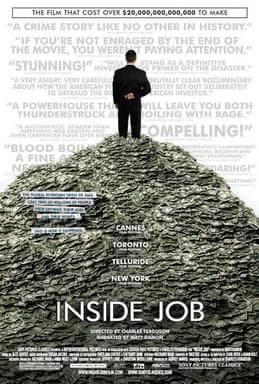
Documentary
Directed by Charles Ferguson
2010 · 1 h 48 min · Summary updated 3 November 2026
Charles Ferguson's Oscar-winning documentary explains the 2008 financial crisis and argues that bankers, regulators and economists caused it and escaped blame. For anyone who wants to understand the crash.
Inside Job argues that the 2008 financial crisis was not an accident. Charles Ferguson traces it to decades of deregulation, a chain of mortgages, CDOs and credit default swaps in which everyone was paid on volume, and rating agencies that gave risky products top marks. When the system collapsed, taxpayers paid for bailouts while executives kept their fortunes and no senior banker was prosecuted. Ferguson also exposes economists who promoted deregulation while working as paid advisers to the industry. In his view, the same people stayed in power after the crash, and the system will not change unless the public demands it.
The documentary opens in Iceland, where, in its account, the government privatized and deregulated the banks around 2000. The banks borrowed heavily and grew far larger than the national economy, while rating agencies kept giving them good marks. When they collapsed in 2008, ordinary citizens paid. Ferguson uses this small case to preview the larger pattern: deregulation, cheap credit, approving ratings and a public left with the bill.
Ferguson argues that the US financial industry was tightly regulated for decades after the Great Depression and then deregulated from the 1980s on. Banks merged into a few giant firms, and derivatives grew with little oversight. The documentary presents the Commodity Futures Modernization Act of 2000, which kept most derivatives unregulated, as a turning point. The lesson in his telling is that rules removed in calm times are missed in a crisis.
Lenders made mortgages, including to borrowers who could not repay. Investment banks bundled the loans into CDOs and sold them to investors. Rating agencies rated many of them AAA. The documentary argues that each link earned fees on volume and passed the risk along, so no one had a reason to check whether loans would be repaid. When incentives reward quantity over quality, quality collapses.
Credit default swaps let firms bet that CDOs would fail, even without owning them. The documentary argues that Goldman Sachs sold CDOs to clients while betting against similar products. Ferguson presents this as a clear conflict between a bank's duty to its clients and its own profit. The point for any investor is to ask whose interests a seller serves and how the seller is paid.
The documentary shows that some people saw the danger. Raghuram Rajan, then chief economist of the IMF, warned of growing risks at the Federal Reserve's 2005 Jackson Hole conference, and the documentary says Lawrence Summers dismissed him. Nouriel Roubini and others also raised alarms. Ferguson's point is that the crisis was predictable, and that people who benefit from a boom have strong reasons not to listen.
Ferguson argues that leading economists who promoted deregulation were also paid advisers to financial firms and often did not disclose it. He confronts Glenn Hubbard of Columbia, who loses his temper, and Frederic Mishkin, who had co-written a report praising Iceland's financial stability. After the documentary, the American Economic Association adopted stricter disclosure rules. The lesson is to ask who pays an expert before trusting the advice.
The documentary argues that executives left failed firms rich, boards paid large bonuses after the bailouts and no senior banker went to prison. It adds that many officials linked to the crisis held top posts under President Obama, including Timothy Geithner and Lawrence Summers. Ferguson presents this as proof that the system protected itself. He ends by arguing that only public pressure will change it.
Availability in the US. Services change their catalogs, so check the price on the service before you pay.
Inside Job is a 2010 documentary about the 2008 financial crisis, directed by Charles Ferguson and narrated by the actor Matt Damon. Ferguson wrote it with Chad Beck and Adam Bolt and produced it with Audrey Marrs. It premiered at the Cannes Film Festival in May 2010, opened in the United States that October and won the Academy Award for Best Documentary Feature in 2011.
Ferguson does not present the crisis as an accident or a natural disaster. He presents it as the result of choices made by bankers, regulators, politicians and economists, many of whom, the documentary argues, profited from those choices and were never held to account. Ferguson has described the subject as the systemic corruption of the United States by the financial industry.
The documentary is built on interviews. Ferguson speaks with Paul Volcker, George Soros, Christine Lagarde, Dominique Strauss-Kahn, Nouriel Roubini, Raghuram Rajan, Eliot Spitzer, Barney Frank, Gillian Tett of the Financial Times, the investor Bill Ackman and many others. He also tells the viewer who refused to talk: according to the documentary, Lawrence Summers, Alan Greenspan, Ben Bernanke, Robert Rubin, Henry Paulson and Timothy Geithner all declined.
The documentary opens in Iceland. In its account, the government deregulated and privatized the country's banks around 2000. The banks then borrowed heavily and grew to many times the size of the national economy. Rating agencies gave them high marks until the end. When the global crisis hit in 2008, they collapsed, and ordinary Icelanders paid the price.
Ferguson uses Iceland as a small model of the larger story: deregulation, cheap credit, reckless banks, approving ratings and a public left with the bill. He also introduces a theme he returns to later. The Columbia economist Frederic Mishkin had co-written a 2006 report that praised Iceland's financial stability. On camera, Ferguson presses him on the report and on why its title later appeared on his résumé as "Financial Instability." Mishkin calls it a typo.
The first part, "How We Got Here," traces the background. The documentary argues that after decades of strict regulation following the Great Depression, the US financial industry was deregulated from the 1980s on. It points to the savings and loan crisis, the merger of banks into a few giant firms and the dot-com bubble, where, it argues, investment banks promoted companies they knew were weak.
In the 1990s, financial derivatives grew fast. The documentary argues that efforts to regulate them were blocked, and it presents the Commodity Futures Modernization Act of 2000, which kept most derivatives unregulated, as a key turning point.
By the 2000s, the documentary says, a small group of firms dominated the system: investment banks such as Goldman Sachs, Morgan Stanley, Lehman Brothers, Merrill Lynch and Bear Stearns; the conglomerates Citigroup and JPMorgan Chase; insurers such as AIG; and the three rating agencies, Moody's, Standard & Poor's and Fitch.
The second part, "The Bubble," explains the machine that built the bubble. Lenders made mortgages, including subprime loans to borrowers who could not repay them. Investment banks bought the loans, bundled them into collateralized debt obligations (CDOs) and sold them to investors. Rating agencies gave many of these products AAA ratings. Each link in the chain was paid on volume, the documentary argues, so no one had a reason to care whether the loans would be repaid.
Credit default swaps let firms bet on whether CDOs would fail, even if they did not own them. The documentary argues that Goldman Sachs sold CDOs to clients while betting against the same kind of products. It also argues that banks took on far more debt relative to their own capital than ever before.
There were warnings. The documentary shows Raghuram Rajan, then chief economist of the International Monetary Fund, presenting a paper on growing risks at the Federal Reserve's 2005 Jackson Hole conference. In its account, Lawrence Summers dismissed the warning.
The third part covers the collapse of 2008 as a fast sequence. Bear Stearns runs out of cash. The government takes over Fannie Mae and Freddie Mac. Lehman Brothers goes bankrupt. Merrill Lynch is sold to Bank of America. AIG is rescued by the government. Treasury Secretary Henry Paulson and Fed Chairman Ben Bernanke ask Congress for a huge bailout, and President George W. Bush signs the Troubled Asset Relief Program. Interviewees describe a global financial system frozen with fear.
The documentary stresses that many of these firms had top credit ratings almost until they failed. It then shows the human cost: lost jobs, foreclosed homes and laid-off workers far beyond Wall Street.
The fourth part asks why so few people paid a price. The documentary argues that top executives left failing firms with their fortunes intact, that boards approved large bonuses after the bailouts and that no senior executive was prosecuted. It also includes interviews about Wall Street's culture of excess, including a therapist who treated bankers and a former madam who describes their spending.
The part that drew the most attention is about economists. Ferguson argues that many leading academic economists who promoted deregulation were also paid consultants, board members or advisers to financial firms, and that they often did not disclose this in their research. He confronts several of them. Glenn Hubbard, dean of Columbia Business School and a former chief economic adviser to President Bush, grows angry and tells Ferguson to "give it your best shot." Mishkin and the Harvard economist John Campbell struggle to answer questions about conflicts of interest. After the documentary's release, the American Economic Association adopted stricter disclosure rules.
The last part looks at the response. The documentary argues that the Obama administration's reforms were weak and that many of the people tied to the crisis stayed in power: Timothy Geithner became Treasury Secretary, Lawrence Summers became a top economic adviser and Ben Bernanke was reappointed to lead the Fed. It notes that some European countries moved to limit bank pay while the United States resisted.
Damon's closing narration argues that the system has not changed and that change will come only if people fight for it.
Most reviews were strongly positive, and critics praised Ferguson's research and his clear handling of complex material. The economist Gene Epstein, writing in Barron's, argued that the documentary gives an incomplete and biased account because it neglects the role of government policy, especially Fannie Mae and Freddie Mac. Peter Rainer of The Christian Science Monitor found it somewhat ahistorical, said it gives too little voice to the people who suffered and found its closing call to action a bit tinny.
Watch it if you want a clear, angry explainer of how the 2008 crisis happened and who, in Ferguson's view, was responsible. Pair it with a book on the role of housing policy for a fuller picture.
Book 1 of 3 · 1949
by Benjamin Graham
Graham's rules for a margin of safety are the opposite of the leverage and hype the documentary describes.
Book 2 of 3 · 2020
by Morgan Housel
Housel explains the greed, fear and overconfidence that drove the bubble, and how to keep them out of your own money.
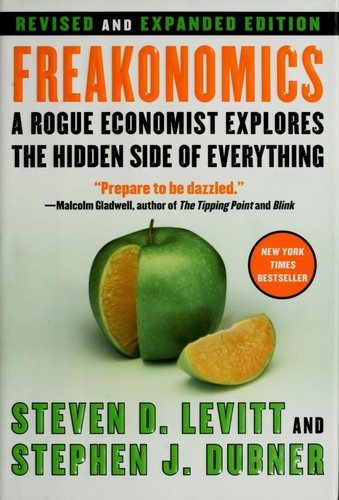
Book 3 of 3 · 2005
by Steven D. Levitt and Stephen J. Dubner
Levitt and Dubner show how incentives drive behavior, the same lens Ferguson uses to explain the crash.
Store links may earn a commission.
11 cards
Question 1 of 5
Which country does Inside Job use as its opening example?
Former Google, Facebook and Twitter insiders explain how social media is built to hold attention, mixed with a scripted family drama. For anyone who wants to understand the attention economy.
Matt D'Avella's documentary follows Joshua Fields Millburn and Ryan Nicodemus, known as The Minimalists, and others who chose to own less in order to live more deliberately. For anyone who feels buried by stuff, debt or busyness.
A three-part National Geographic docuseries in which Jared Diamond argues that geography, not people, explains why Europeans conquered so much of the world. For anyone curious about the roots of global inequality.

Documentary · 2010
Directed by Heidi Ewing, Alex Gibney, Seth Gordon, Rachel Grady, Eugene Jarecki and Morgan Spurlock
Six documentary makers adapt Levitt and Dubner's bestseller into segments on baby names, cheating in sumo, crime and abortion, and paying students for grades. For anyone who wants the book's ideas on screen.
New books, occasionally