
Michael A. Singer's guide to stepping back from the voice in your head, keeping your heart open and letting go of the fears that run your life. For readers drawn to meditation and nondual spirituality.
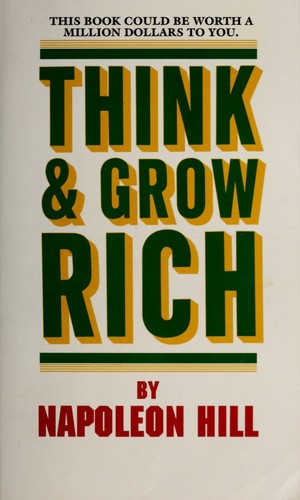
1937 · 256 pages · Summary updated 24 October 2026
Napoleon Hill's 1937 formula for wealth: a burning desire, a definite plan, faith, persistence and a mastermind group. For readers who want to know what the oldest success book actually says.
Hill claims that riches begin with a burning desire for a definite amount of money, backed by a written plan and repeated until the subconscious mind accepts it as fact. His 13 steps run from desire and faith through autosuggestion, specialized knowledge, imagination, organized planning, decision and persistence to the mastermind, the subconscious and a sixth sense. He presents the formula as the distilled method of Andrew Carnegie, Henry Ford and Thomas Edison. The book ends with the six ghosts of fear (poverty, criticism, ill health, loss of love, old age, death) and a self-test for rooting them out. The Carnegie commission and the method's results have never been verified.
Hill's opening claim is that a thought held with definite purpose, faith and a burning desire turns into its physical equivalent. His proof is Edwin C. Barnes, who arrived at Thomas Edison's lab with nothing and announced he would be Edison's partner. He swept floors for years, then took on the unwanted job of selling the Ediphone and sold it so well that he got the partnership. Hill's reading: Barnes did not hope. He decided, left himself no retreat and acted on the one opening that appeared.
Vague wishes for money produce nothing. Hill's six steps are specific: fix the exact sum, decide what you will give for it, set a date, make a plan and start now, write it all down, and read the statement aloud twice a day while picturing the money as already yours. He tells of his son Blair, born without ears, whom he told for years that his condition was an asset. Blair learned to hear. Hill treats this as the method working on a physical limit.
Hill says the subconscious mind accepts whatever it is told repeatedly with emotion, and then shapes action toward it. Repetition without feeling does nothing. The self-confidence formula he gives is a daily script: a stated purpose, 30 minutes a day picturing the person you intend to become, and a promise to act only in ways that help others too. He argues that faith is not a mystery but a state of mind induced by this practice. The same mechanism, he warns, also works for fear and doubt.
Hill separates general knowledge from specialized knowledge organized toward a goal. His example is Henry Ford, sued for libel by the Chicago Tribune after it called him ignorant. Asked trivia questions in court, Ford said he had buttons on his desk that could summon a man with any answer he needed. Hill's lesson: wealth comes from directing knowledge, not storing it. He tells readers to list what they need to know, find who has it and pay or partner for it.
Hill says every rich person he studied made decisions quickly and changed them slowly, while people who failed did the reverse. He pairs decision with persistence, which he calls the quality most people lack. R. U. Darby's uncle quit a Colorado gold mine three feet from a rich vein that a junk dealer later found. Darby turned the lesson into a career selling life insurance. Hill lists the signs of weak persistence: no clear goal, procrastination, blaming others and compromising at every turn.
A mastermind is two or more people working in harmony toward a definite purpose. Hill says Andrew Carnegie credited his fortune to a group of about 50 such people, and that Henry Ford's rise followed his friendships with Edison, Firestone and Burbank. He claims that minds in harmony create a third force that none of them has alone. The practical instruction is to recruit a small alliance, give its members a reason to help you and meet with them often. No one, he says, gets rich alone.
Hill names six ghosts of fear: poverty, criticism, ill health, loss of love, old age and death. Each has symptoms, such as indecision, worry, self-consciousness and procrastination. He adds a seventh evil, openness to other people's negative influence, and tells readers to cut off anyone who makes them feel small. The book ends with a long self-analysis questionnaire. His closing point: the only thing a person fully controls is their own mind, so that is where wealth starts.
“Whatever the mind of man can conceive and believe, it can achieve.”
Napoleon Hill was a journalist from rural Virginia. He says that in 1908 the steel magnate Andrew Carnegie gave him a commission: spend 20 years interviewing the most successful men in America and distill their methods into a philosophy anyone could use. Hill says he interviewed Henry Ford, Thomas Edison, John D. Rockefeller, Theodore Roosevelt, F. W. Woolworth and hundreds of others. The result was the eight-volume The Law of Success in 1928 and this shorter book in 1937, in the middle of the Great Depression.
Hill writes that the book contains a secret, one that Carnegie used and that appears in every chapter but is never stated outright. Readers who are ready, he says, will recognize it. Most readers take the secret to be the opening idea: thoughts are things, and a thought held with desire and faith becomes its physical equivalent.
He opens with the story of Edwin C. Barnes, who arrived at Thomas Edison's lab in New Jersey with no money and no connections. Barnes announced that he was going to be Edison's business partner. Edison gave him a floor-sweeping job. Barnes waited for years, then took on the job of selling the Ediphone dictating machine that nobody else wanted. He sold it so well that he became the partner he had declared himself to be. Hill's point: Barnes did not wish for partnership. He decided on it, burned his bridges and refused any other outcome.
A second story gives the book its most repeated phrase. R. U. Darby and his uncle struck gold in Colorado, raised money for machinery, then hit a dead vein. They sold the equipment to a junk dealer for a few hundred dollars and went home. The junk dealer hired a mining engineer, who found the vein again three feet from where the Darbys had stopped. Darby later became a top life insurance salesman because he learned to keep going when he felt like quitting. Hill calls this stopping three feet from gold.
The book is built on 13 steps toward riches. The first is desire. Hill says that wishing is not enough. A person must want money with a burning intensity that becomes an obsession. He gives a six-step method:
Hill illustrates desire with his own son, Blair, born without ears. Hill says he refused to accept that the boy would be deaf and repeated to him for years that his condition was an asset, not a handicap. Blair learned to hear, and as an adult he worked with a hearing-aid company. Hill presents this as proof that desire backed by faith can override physical facts. He also tells of Henry Ford, who ordered his engineers to build a V-8 engine with all eight cylinders in one block. They said it was impossible. Ford told them to keep at it until they succeeded, and after a year they did.
The second step is faith, which Hill defines as a state of mind that can be induced by repeating instructions to the subconscious. He offers a self-confidence formula to recite daily: I know I can achieve my definite purpose, I will spend 30 minutes a day picturing the person I intend to become, I will spend 10 minutes a day building self-confidence, I have a written statement of my chief aim, and I will act only in ways that serve everyone involved.
The third step, autosuggestion, is the mechanism. Hill says the subconscious mind accepts any thought that is repeated with emotion. Dry, flat repetition does nothing. The reader must mix the words with feeling until belief takes hold. He frames this as the link between the conscious mind and the subconscious, which in turn connects to what he calls Infinite Intelligence.
Step four is specialized knowledge. Hill distinguishes general knowledge, which he says is close to useless for making money, from knowledge organized toward a definite end. His example is Henry Ford, who was sued for libel by the Chicago Tribune after it called him ignorant. In court, lawyers asked him trivia questions about history. Ford answered that he had a row of buttons on his desk, and could press one and summon a man who could answer any question he needed. Hill's lesson: you do not need to hold the knowledge yourself. You need to know where to get it, which leads to the mastermind idea later in the book.
Step five is imagination. Hill separates synthetic imagination, which rearranges old ideas into new combinations, from creative imagination, which he says receives hunches and inspirations from outside the conscious mind. His examples are commercial. A country doctor sold an old kettle and a secret formula to a drug clerk named Asa Candler, who added imagination and built Coca-Cola. A young preacher, Frank Gunsaulus, announced a sermon titled "What I would do if I had a million dollars," and a meatpacker in the audience, Philip Armour, gave him the money to found a technical institute. Ideas, Hill says, have no fixed price.
Step six is organized planning. Hill argues that no one accumulates wealth alone. The reader should form an alliance with as many people as needed, offer them something in return and meet with them regularly. If the first plan fails, replace it with a new plan at once. Hill then spends many pages on how to get a job: how to write a brief, how to sell personal services and a long list of the 31 major causes of failure, including lack of a definite purpose, lack of self-discipline, procrastination and the habit of trying to get something for nothing. He also lists the attributes of a leader, such as courage, self-control, a keen sense of justice and taking full responsibility for the mistakes of followers.
Step seven is decision. Hill says that in his study of the wealthy, every one of them reached decisions quickly and changed them slowly, while people who failed did the opposite. He warns against being talked out of decisions by friends and relatives with opinions and no facts. His large example is the Declaration of Independence: 56 men signed a document that could have hanged them, and Hill presents the Continental Congress as a mastermind group that reached a decision and backed it with everything they had.
Step eight is persistence, and Hill treats it as the step that most people lack. He lists symptoms of its absence: failure to define what you want, procrastination, willingness to compromise on all occasions, blaming others and the habit of quitting at the first sign of defeat. He says persistence has four parts: a definite purpose, a definite plan, a mind closed against negative influences and a supportive alliance. His examples include the novelist Fannie Hurst, who received dozens of rejection slips before her first sale, and the singer Kate Smith, who sang for years for no pay. He also retells the 1936 abdication of Edward VIII, who gave up the British throne to marry Wallis Simpson, as an example of a decision made with full persistence against enormous pressure.
Step nine is the mastermind, which Hill defines as the coordination of knowledge and effort between two or more people working in harmony toward a definite purpose. He claims that when minds meet this way, a third, invisible force is created that is more than the sum of the parts. Carnegie, he says, had a mastermind of about 50 men and credited his entire fortune to it. Henry Ford's rise, Hill argues, dates from his friendship with Edison and later with Harvey Firestone, John Burroughs and Luther Burbank.
Step ten, sex transmutation, is the chapter that most dates the book. Hill argues that sexual desire is the strongest human drive and that people who channel it into their work, rather than spending it, gain creative energy and charisma. He claims that most men do not succeed before 40 because they waste this energy in their twenties and thirties. He lists ten stimuli of the mind, with sexual desire at the top, followed by love, a burning desire for fame or money, music and friendship. Love, he says, refines the energy and makes it productive.
Step eleven is the subconscious mind. Hill says it never sleeps, takes in every thought and emotion and acts on the dominant ones. He lists seven positive emotions (desire, faith, love, sex, enthusiasm, romance, hope) and seven negative ones (fear, jealousy, hatred, revenge, greed, superstition, anger) and argues that the two sets cannot occupy the mind at the same time. Step twelve is the brain, which Hill describes as a broadcasting and receiving station for thought, a claim he supports by citing Dr. J. B. Rhine's telepathy experiments at Duke University.
Step thirteen is the sixth sense, which Hill treats as the summit of the philosophy. He says it works only after the other twelve steps are in place. He describes his own practice of invisible counselors: every night, he imagined a meeting with nine famous men, including Emerson, Paine, Edison, Darwin, Lincoln, Napoleon, Ford and Carnegie, and asked each to lend him a trait. He says the meetings felt so real that he stopped them for months, and he states that he knows they were imaginary.
The final chapter is on fear, which Hill says blocks the whole method. He names six basic fears: fear of poverty, fear of criticism, fear of ill health, fear of loss of love, fear of old age and fear of death. For each, he lists symptoms. Fear of poverty shows as indifference, indecision, doubt, worry, overcaution and procrastination. Fear of criticism shows as self-consciousness, lack of poise and an inferiority complex. Fear of death, he argues, is the cruelest because death is either a long sleep or a passage to something better, and neither should be feared.
He adds a seventh evil: susceptibility to negative influences from other people. His defense is to control your own mind and to refuse the company of anyone who makes you feel small. The chapter ends with a long self-analysis questionnaire. Sample questions: Do you complain of feeling bad, and if so, why? Do you find fault with others? Do you change your mind often? Are you influenced by others against your own judgment? The only thing you fully control, Hill concludes, is your own thought, and that control is the entire basis of the book.
The Carnegie story has no independent evidence. No record of a meeting between Hill and Carnegie exists, Carnegie's papers do not mention Hill, and Hill first told the story after Carnegie died. Biographical research, including a 2016 investigation by journalist Matt Novak, documents a career of failed ventures, fraud charges and claims that cannot be confirmed. The method itself is untestable: Hill explains every failure as a lack of desire, faith or persistence, so no outcome can count against it. Readers also note the survivorship bias in the examples, which all come from people who succeeded, and the claims about telepathy, infinite intelligence and sex energy, which rest on no accepted science. The chapter on sex transmutation reflects the gender assumptions of its time.
Read it if you want the original source of the positive-thinking tradition that runs through later books from The Power of Positive Thinking to The Secret. The useful core is small and practical: write down a specific goal, make a plan, act, keep going, and choose your company. Treat the rest as history.
12 cards
Question 1 of 5
Who does Hill say commissioned the 20-year study behind the book?
Michael A. Singer's guide to stepping back from the voice in your head, keeping your heart open and letting go of the fears that run your life. For readers drawn to meditation and nondual spirituality.
JL Collins's letters to his daughter on building wealth with one index fund, no debt and a high savings rate. For anyone who wants a plan they can follow without watching the market.
Ryan Holiday turns a line from Marcus Aurelius into a three-part method for handling setbacks: perception, action and will. For anyone stuck behind a problem who wants a Stoic way through it.
Brianna Wiest on why people sabotage their own goals and how to turn that pattern into self-mastery. For anyone who keeps getting in their own way.
New books, occasionally