Mitch Albom's record of fourteen Tuesday visits with his dying college professor, Morrie Schwartz, and the lessons on love, work, family and death that came out of them. For readers who want a short book on how to live.
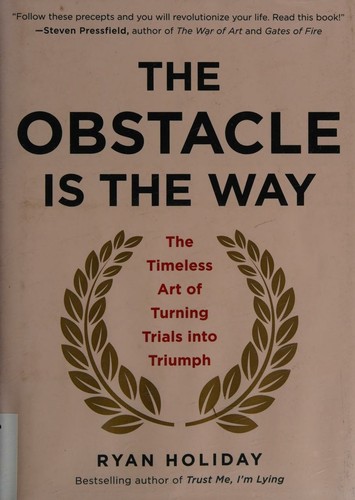
by Ryan Holiday
2014 · 224 pages · Summary updated 24 October 2026
Ryan Holiday turns a line from Marcus Aurelius into a three-part method for handling setbacks: perception, action and will. For anyone stuck behind a problem who wants a Stoic way through it.
Ryan Holiday builds the book on one line from Marcus Aurelius: what stands in the way becomes the way. Obstacles are not just to be endured. They are the raw material of progress. The method has three parts. Perception: see the obstacle calmly and objectively, without panic or self-pity, and ask what in it is up to you. Action: get moving, persist, iterate, follow the process and attack from the flank instead of head-on. Will: build an inner citadel for what you cannot change, expect setbacks, love your fate and remember that you will die. Stories of Rockefeller, Demosthenes, Grant, Edison, Earhart and others show each step in practice.
Holiday's thesis comes from Marcus Aurelius: what stands in the way becomes the way. An obstacle is not a detour from the path. It is the path, because it contains the exact opportunity it appears to block. John D. Rockefeller treated the Panic of 1857 as an education in how people lose money, and he used every later crisis to learn and to buy. Holiday argues that this attitude can be trained, and the book's three disciplines are the training: perception, action and will.
The first discipline is to see an obstacle without fear, judgment or self-pity. Holiday takes the Stoic practice of objective description, where Marcus Aurelius called a purple robe wool dyed with shellfish blood, and applies it to problems: describe yours in plain terms, as if it belonged to a friend. Rubin "Hurricane" Carter, wrongly imprisoned for nineteen years, refused to see himself as a prisoner and spent the time studying. The event stays the same. The size it takes up in your mind is yours to set.
Holiday borrows Epictetus's first rule: some things are in our control and some are not, and misery comes from confusing them. Pitcher Tommy John faced a torn ligament in 1974 that would have ended his career. He asked what was in his control, found an experimental surgery, took the chance and pitched for many more seasons. The surgery now carries his name. Holiday's advice is to spend no energy on the uncontrollable part of a problem and all of it on the controllable part, however small.
In 1928, Amelia Earhart was offered a seat on the first transatlantic flight by a woman, but only as a passenger while two men flew. It was an insult. She took it, because it was a start, and within a few years she crossed the Atlantic alone. Holiday argues that waiting for the perfect opening is a form of fear. Action begins with the imperfect opportunity in front of you, and persistence means trying different approaches, as Edison did with filaments and Grant did at Vicksburg, until one works.
Nick Saban taught Alabama's football players to ignore the championship and focus on the next play, done right. He called this the Process. Holiday argues that big goals paralyze and small steps do not. He pairs this with a lesson from military history: almost no battle was won by a frontal assault against a prepared enemy. Washington won at Trenton by surprise, and Gandhi beat the British by letting their violence expose itself. Find the weak side of a problem instead of the side that looks strongest.
The third discipline is for obstacles that do not move. Theodore Roosevelt was a sickly, asthmatic child whose father told him to build his body. Years of training gave him a strength that carried him through losing his wife and mother on the same day. Holiday calls this the inner citadel, the Stoic term for a fortress inside that no event can breach. It is built in advance, through practice and through premeditatio malorum, the rehearsal of what might go wrong, so that setbacks lose their power to shock.
When fire destroyed Thomas Edison's laboratory in 1914, he told his son to fetch his mother so she could see a fire like no other, and the next day he said it had burned up a lot of rubbish. Holiday pairs this with Nietzsche's phrase amor fati, love of fate. The attitude goes beyond acceptance. It welcomes the event as material. Jack Johnson smiled through a hostile crowd in his 1910 fight with Jim Jeffries. The lesson is that cheerfulness in the face of a setback is a choice, and it is the choice that keeps you effective.
James Stockdale survived more than seven years as a prisoner of war by focusing on his duty to the other prisoners. Holiday argues that an obstacle shrinks when you face it for someone other than yourself. He adds the Stoic practice of memento mori: Montaigne nearly died in a riding accident and lost his fear of death, which freed him to live. Remembering mortality puts small obstacles back in their proper size. The final chapter warns that there is no end state. Behind each obstacle is the next, so the disciplines are a way of living, not a trick.
“The impediment to action advances action. What stands in the way becomes the way.”
Ryan Holiday was director of marketing at American Apparel and a media strategist before he became the most popular modern writer on Stoicism. The Obstacle Is the Way came out in 2014 and found its first large audience in professional sports. Coaches and players on teams including the New England Patriots and the Seattle Seahawks passed it around, and it became a staple in locker rooms and front offices before it reached the business world.
The book rests on a passage from Book 5 of the Meditations of Marcus Aurelius, the Roman emperor who wrote private notes to himself during his wars on the Danube frontier. In Gregory Hays's translation it reads: the impediment to action advances action, and what stands in the way becomes the way. Holiday reads this as a formula. Obstacles are not merely things to endure on the way to success. They are the path. Each one contains the exact opportunity it seems to block.
He sets up the thesis with John D. Rockefeller. In 1857, Rockefeller was a young bookkeeper in Cleveland when a financial panic wiped out businesses across the country. Instead of panicking, he watched. He studied how people lost money and how the survivors behaved. He took the panic as an education, and over the following decades he treated every crisis, from the Civil War to later market crashes, as a chance to buy, learn and consolidate. Holiday's point is not that Rockefeller was lucky but that he had trained himself to see disruption as information.
Holiday states the structure plainly. There are three disciplines, drawn from the way the Stoics organized their practice. Perception is how we see and understand what happens. Action is the energy and creativity we bring to a problem. Will is our inner strength for the things we cannot change. Each part of the book takes one discipline and illustrates it with short chapters, each built around a historical figure.
The first discipline is to see events as they are, stripped of fear, judgment and the drama we add to them. Holiday opens with Rubin "Hurricane" Carter, the boxer wrongly convicted of murder in 1966. Carter told the prison warden that he would not wear a uniform, eat prison food or work a prison job, because he had committed no crime. He spent his time in the law library and in philosophy books, and he treated the cell as a place he was passing through. He was released in 1985. Holiday's lesson is that Carter kept the one thing the prison could not take: his choice of how to see his situation.
Several chapters follow, each a rule for perception.
Steady your nerves. Ulysses S. Grant sat for a photograph during the Civil War when a shell exploded nearby. Everyone else dove for cover. Grant did not move. Holiday argues that calm under pressure is a skill built by exposure, not a gift.
Control your emotions. Holiday describes how NASA trained the first astronauts, including John Glenn, through endless repetition of every possible failure so that nothing in orbit would feel new. The goal was to make the body stop reacting to surprises. He calls the result domesticating your emotions.
Practice objectivity. Marcus Aurelius described a fine meal as a dead animal and a purple robe as wool dyed with shellfish blood. Holiday asks the reader to describe their problem in the same plain way, as if it belonged to someone else. The advice you would give a friend is the advice you should take.
Alter your perspective. The Athenian general Pericles, facing a solar eclipse that terrified his crew, covered a sailor's eyes with his cloak and asked whether that frightened him. The sailor said no. Pericles asked what difference it made that something larger than a cloak was blocking the sun. Reframing does not change the event. It changes its size.
Is it up to you? Holiday uses the pitcher Tommy John, who faced a torn ligament in 1974 that would have ended his career. He asked what was in his control: trying an experimental surgery that had never been done on a pitcher. He took it, came back and pitched for many more seasons. The surgery now carries his name. The Stoic rule is to sort every situation into what is up to you and what is not, and to spend energy only on the first.
Live in the present moment. Holiday argues that most anxiety comes from projecting into the future. Focus on the step in front of you. The obstacle becomes smaller when it is only today's piece of it.
Think differently. Steve Jobs's colleagues called his refusal to accept limits a reality distortion field. Engineers told him something was impossible, and he insisted until they found a way. Holiday is careful to say this is not denial. It is a refusal to accept the first answer as final.
Finding the opportunity. Laura Ingalls Wilder's family endured hardship on the Great Plains, and she later turned those years into books. Holiday's broader claim is that every obstacle hides a benefit: a weakness in an opponent, a lesson, a chance to practice a virtue. The job of perception is to find it.
The section ends with Prepare to act. Seeing clearly is only the start. Perception without action is just a better view of the wall.
The second discipline opens with Demosthenes, the Athenian orator. He was born sickly and with a speech impediment, and his guardians stole his inheritance. He trained himself by speaking with pebbles in his mouth, reciting over the roar of the sea and shaving half his head so that he would be too ashamed to go out and would stay inside practicing. Then he took his guardians to court and won. Holiday uses him to show that action means directed, persistent, sometimes ugly effort.
Get moving. In 1928, Amelia Earhart was offered a place on the first transatlantic flight by a woman, but only as a passenger, with two men flying the plane. It was an insult. She took it anyway, because it was a start. Within a few years she was flying the Atlantic alone. Holiday's rule is that you begin with what is available and build from there.
Practice persistence. Thomas Edison tested thousands of materials before he found a filament that worked. Grant spent months on failed approaches to Vicksburg before he found one that took the city. Persistence is not stubbornness. It is the willingness to keep trying different things.
Iterate. Holiday borrows from Silicon Valley the idea of the minimum viable product. Ship something, learn from the failure and ship again. Failure is feedback, and the only real failure is not using it.
Follow the process. Nick Saban, the University of Alabama football coach, taught his players to ignore the scoreboard and the championship and to focus only on the next play, done correctly. He called this the Process. Holiday argues that big goals paralyze and small steps do not, so you break every obstacle into the next action.
Do your job, do it right. Andrew Johnson, who became president, was a tailor and kept saying so. Holiday's rule is that no task is beneath you, and that doing small things well is how you earn larger ones.
What's right is what works. Samuel Zemurray built a banana empire in Central America by ignoring the rules that larger rivals followed. When two men claimed the same piece of land in Honduras, he bought it from both. Holiday is not endorsing every tactic. He is making the point that pragmatism beats pride.
In praise of the flank attack. Holiday notes that very few battles in history were won by a frontal assault against a prepared enemy. George Washington's winning moves, such as the Christmas crossing to Trenton, were indirect. The lesson is to attack a problem from the side, where it is weakest, instead of where it looks strongest.
Use obstacles against themselves. Gandhi did not fight the British army. He let the empire's violence expose itself against unarmed marchers. Sometimes the best action is to let an opponent's force work against them.
Channel your energy. Arthur Ashe played tennis with a calm face and an explosive game. Holiday's point is that discipline on the outside allows freedom on the inside.
Seize the offensive. In 2008, when the controversy over his pastor threatened to end Barack Obama's campaign, he gave a major speech on race instead of issuing a denial. He turned a crisis into a platform. Holiday argues that the moment of greatest pressure is often the moment of greatest opening.
The section ends with Prepare for none of it to work. Some obstacles do not move no matter how well you act. That is where the third discipline begins.
Holiday opens the third part with Abraham Lincoln, who suffered from severe depression for most of his adult life. Lincoln did not cure it. He accepted it, and Holiday argues that living with his own suffering gave him the patience and humility to carry the country through the Civil War. Will, in the Stoic sense, is not willpower. It is the quiet acceptance of what cannot be changed, combined with the resolve to keep going.
Build your inner citadel. Theodore Roosevelt was an asthmatic, sickly child. His father told him he had the mind but not the body, and that he would have to make his body. Roosevelt built a gym and spent years training, and the discipline carried him through later losses, including the deaths of his wife and mother on the same day. Holiday borrows the term inner citadel from the Stoics: a fortress inside that no outside event can breach.
Anticipation (thinking negatively). The Stoics practiced premeditatio malorum, the rehearsal of what could go wrong. Holiday describes how a pre-mortem, imagining a project has already failed and asking why, makes plans sturdier. Expecting setbacks removes their power to shock.
The art of acquiescence. Thomas Jefferson had a weak speaking voice, so he became a writer instead of an orator. Edison lost most of his hearing and said it helped him concentrate. Holiday argues that accepting a limit frees energy for the paths that remain open.
Love everything that happens: amor fati. In 1914, a fire destroyed much of Edison's laboratory and factory. He was 67. He told his son to fetch his mother and her friends, because they would never see a fire like this again. The next morning he said the fire had burned up a lot of rubbish and that they would rebuild. Holiday pairs this with the boxer Jack Johnson, who smiled through his 1910 fight against Jim Jeffries while the crowd screamed abuse. Nietzsche's phrase amor fati, love of fate, is the attitude Holiday wants: not just accepting what happens but welcoming it.
Perseverance. Holiday contrasts persistence, which is effort on a single problem, with perseverance, which is endurance over a whole life of problems. Odysseus's ten-year journey home is his example.
Something bigger than yourself. James Stockdale, the Navy pilot held for more than seven years in a North Vietnamese prison, survived by focusing on the other prisoners and on his duty to them. Holiday argues that an obstacle shrinks when you face it for someone other than yourself.
Meditate on your mortality. The French essayist Michel de Montaigne nearly died in a riding accident and came away relieved of his fear of death. Holiday follows the Stoic practice of memento mori: remembering that you will die, so that small obstacles regain their proper size and time is not wasted.
Prepare to start again. The final chapter admits that there is no end state. Behind every obstacle is another one. The disciplines are not a technique for finishing but a way of living.
Holiday closes with a short restatement of the whole approach. First, see clearly: strip the event of judgment, separate what is in your control from what is not, and look for the opportunity inside the problem. Second, act: start with what you have, persist, iterate, follow the process, attack from the flank and seize the moment when it comes. Third, endure: accept what cannot be changed, expect setbacks, love your fate and keep your purpose larger than yourself. He argues that the three disciplines reinforce each other. Clear perception makes action possible. Action builds the confidence that feeds will. Will keeps you steady enough to perceive the next obstacle clearly.
He also addresses the obvious objection. Not every obstacle has a happy ending. Carter spent nineteen years in prison. Lincoln was murdered. Stockdale was tortured. The claim is not that obstacles always lead to victory. It is that the way you meet them is the only part that is always yours, and that meeting them well is itself the victory the Stoics cared about.
Reviewers note that the book argues by anecdote. Each chapter picks a figure whose setback worked out, and the many people who did the same things and failed do not appear, so the lessons carry a survivorship bias. Classicists point out that Holiday uses Stoicism loosely and that the original philosophy was more concerned with virtue than with winning. Some readers also find the chapters short and repetitive, and the business and sports framing at odds with Marcus Aurelius's private, searching tone.
Read it if you are facing a specific setback and want a practical frame for handling it rather than a full course in Stoic philosophy. It is short, built for rereading, and works well alongside the Meditations itself.
12 cards
Question 1 of 5
Whose writing gives The Obstacle Is the Way its title?
Mitch Albom's record of fourteen Tuesday visits with his dying college professor, Morrie Schwartz, and the lessons on love, work, family and death that came out of them. For readers who want a short book on how to live.
Napoleon Hill's 1937 formula for wealth: a burning desire, a definite plan, faith, persistence and a mastermind group. For readers who want to know what the oldest success book actually says.
Michael A. Singer's guide to stepping back from the voice in your head, keeping your heart open and letting go of the fears that run your life. For readers drawn to meditation and nondual spirituality.

Machiavelli's 1513 manual on how a ruler gains and keeps power, written for the Medici after his fall from office in Florence. For readers who want the argument behind the word Machiavellian.
New books, occasionally