Flowers for Algernon

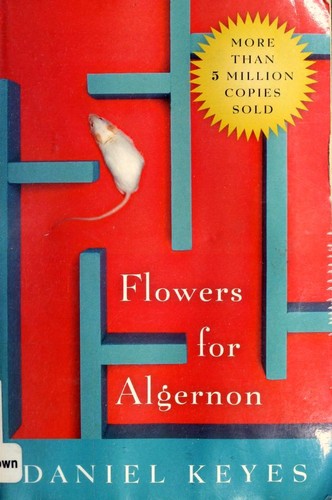
by Daniel Keyes

1966 · 311 pages · Summary updated 6 November 2026

Daniel Keyes's novel told in the progress reports of Charlie Gordon, a man with an IQ of 68 whose intelligence is raised by surgery, and the mouse Algernon who shows him where it leads. For readers who want the plot, the characters and the meaning.

Get the book

Links may earn a commission.

The gist

Charlie Gordon is 32, has an IQ of 68 and sweeps floors at a bakery. Scientists at Beekman University pick him for an operation that has raised the intelligence of a white mouse named Algernon. The book is Charlie's own progress reports, and as his mind grows the spelling corrects itself and the sentences lengthen. Intelligence shows him that his coworkers laughed at him, that his mother rejected him and that the scientists see him as a specimen. He falls for his teacher Alice, meets the painter Fay and tracks down his family. Then Algernon starts to decline. Keyes's argument is that intelligence without feeling is empty and that a person's worth never depended on an IQ score.

Key ideas

  1. 01

    The progress reports let you watch a mind change

    Keyes tells the whole story in Charlie's own reports. The early ones are short and misspelled, and the later ones are fluent and dense. The form does what no outside narrator could: the reader measures Charlie's intelligence by the prose, not by a number. The reasoning is that a change this large has to be felt, not reported. The example is the inkblot test, which Charlie describes more than once. First he cannot see pictures and feels stupid. Later he understands the test and remembers the first attempt with shame.

  2. 02

    Intelligence reveals cruelty that ignorance hid

    Charlie thinks Joe Carp and Frank Reilly are his friends. When he gets smarter, he understands that they took him to parties to laugh at him, and that "pulling a Charlie Gordon" was a joke at his expense. Keyes argues that the kindness of a low-IQ life is often an illusion created by not understanding. The example is the diner scene. A dishwasher drops a tray, the customers laugh, and Charlie laughs too, until he sees himself in the boy and shouts that he is a human being.

  3. 03

    A person is a person before and after the operation

    Nemur and Strauss talk about Charlie as a thing they made. Charlie tells them he was a person before the surgery and that nobody saw it. Keyes puts the moral claim of the book here: worth is not a function of IQ. The reasoning runs through the whole plot, because the people who treat Charlie best, Alice at the start and the bakery workers at the end, do so without regard to his score. The example is the Chicago convention, where Nemur presents Charlie beside Algernon as two exhibits.

  4. 04

    A mind can outrun its emotions

    Charlie's IQ rises in months, but his emotional life is still that of the frightened boy his mother raised. He panics with Alice because the old Charlie seems to watch from a corner. Keyes argues that intelligence and emotional maturity grow on different clocks, and that forcing one does not move the other. The example is the contrast between Alice and Fay. With Alice, who knew the old Charlie, he freezes. With Fay, who knows nothing, he is free, but the relationship is shallow.

  5. 05

    Family explains the fear, not the fault

    Charlie's memories return with his intelligence. His mother Rose refused to accept him, punished him and finally sent him away. His father Matt gave in. His sister Norma resented him. Keyes uses these flashbacks to explain Charlie's terror of women and his need to be liked. He does not excuse Rose, but he shows her panic. The example is Charlie's visit to Matt's barbershop, where his father shaves him without recognizing him and Charlie decides not to tell him who he is.

  6. 06

    Science has limits, and the scientists have egos

    Charlie finds that Nemur has not read the foreign research and that the project was rushed to a conference. His own paper on the Algernon-Gordon Effect finds the flaw the experts missed. Keyes argues that a scientist's reputation can block honest inquiry, and that the subject of an experiment has a right to its results. The example is Charlie taking over the research on Algernon's decline, because the people who ran the experiment are not willing to see where it leads.

  7. 07

    Losing the gift is not the same as losing the self

    As Charlie declines, he loses languages, books and finally the ability to write clearly. What he keeps is what he learned about his family, his friends and his own worth. The bakery workers who once mocked him now defend him against a bully. Keyes argues that the experiment failed as science but succeeded as a life. The example is the last report, where Charlie says he is glad he got a second chance and asks for flowers on Algernon's grave.

Full summary

A progress report from Charlie Gordon

Flowers for Algernon began as a short story in 1959. It won the Hugo Award, and Daniel Keyes expanded it into a novel in 1966, which shared the Nebula Award for best novel. Keyes drew on his years teaching English to students in special classes in New York. One of them, he said, asked whether he could become smart if he worked hard enough.

The novel is told entirely in progress reports written by Charlie Gordon. Charlie is 32 years old, with an IQ of 68. He sweeps floors and runs deliveries at Donner's Bakery in New York, and he goes to a night class for adults with low IQ at Beekman University, where Alice Kinnian teaches him to read and write. Two scientists at the university, Professor Nemur and Dr. Strauss, have developed a surgical procedure that raises intelligence. It has worked on a white mouse named Algernon, who can now beat Charlie through a maze. Alice recommends Charlie for the experiment because he wants to learn more than any student she has had.

The first reports are short and full of spelling errors. Charlie writes "progris riport" and describes the inkblot test, which confuses him because he cannot see any pictures in the ink. The form of the book is its main device. As Charlie's mind grows, the spelling corrects itself, the sentences lengthen, and the vocabulary expands. The reader watches the change happen on the page.

The operation and the climb

Charlie has the operation in March. Nothing seems to change at first, and he is frustrated that he is still losing races to Algernon. Then the gains come fast. He learns punctuation, reads whole books, picks up languages and begins to understand things that were hidden from him before.

The first thing intelligence shows him is what his life had actually been. At the bakery, his coworkers Joe Carp and Frank Reilly had called a stupid mistake "pulling a Charlie Gordon." They took him to parties to laugh at him. He had thought they were his friends. He also discovers that Gimpy, the head baker, is stealing from Mr. Donner. Charlie has to decide what to do, and he realizes that moral questions are hard for anyone, not just for a man with a low IQ. He confronts Gimpy, and the stealing stops.

Mr. Donner promotes Charlie to the mixing machines, but the workers grow uneasy around him. Frank and Joe stop talking to him. The staff signs a petition, and Donner lets Charlie go. His IQ passes 185. He now knows more than the scientists who made him, and he can see their vanity and their limits. He tells Nemur that he was a person before the operation too, and that nobody treated him like one.

One scene stays with most readers. In a diner, a young dishwasher with a low IQ drops a tray of dishes. The crowd laughs, and Charlie laughs with them. Then he sees the boy's blank, eager smile and understands that he is watching himself. He shouts at the customers that the boy is a human being. From then on he wants to use his mind for people like the one he was.

Alice, Fay and the other Charlie

Charlie falls in love with Alice Kinnian. She cares for him and admits that she feels the same. But every time they get close, Charlie panics. He feels that the old Charlie is still inside him, watching from a dark corner, and the feeling comes from his childhood. His mind has outgrown his emotions. Soon it has outgrown Alice too. He grows impatient when she cannot follow his thinking, and they drift apart.

He moves into an apartment and meets Fay Lillman, a painter who lives across the hall. Fay is free, funny and careless. She knows nothing about his past, so the old Charlie does not get in the way. With her he drinks, dances and sleeps. But Fay cannot share his work, and the relationship stays shallow.

Keyes uses these two women to show two halves of Charlie. Alice belongs to the person he was and the person he wants to be. Fay belongs to the person he has become for a short time. Neither can hold the whole man.

The family: Rose, Matt and Norma

The operation also unlocks memory. Charlie remembers his mother, Rose, who refused to accept that he was different. She punished him for wetting himself and dragged him to doctors who promised cures. When his sister Norma was born normal, Rose turned on him and treated him as a danger to her. His father, Matt, tried to protect him but gave in. Rose finally forced Matt to send Charlie away, and he ended up with an uncle and then at the Warren State Home.

Charlie now understands where his sexual panic comes from. Rose had threatened him with a knife when he was a teenager to make sure he never touched a girl. The terror is still in him.

He tracks his father to a barbershop in the Bronx. Matt gives him a shave and never recognizes him. Charlie does not say who he is. Later he visits Rose and Norma in Brooklyn. Rose is old and confused. Norma, who used to resent him, welcomes him and says she is sorry. Then Rose, in a moment of panic, picks up a kitchen knife and orders him out, convinced that he is going to hurt Norma. Charlie leaves. He has got what he came for: he knows who his family were, and he can stop hating them.

Chicago and the Algernon-Gordon Effect

Nemur and Strauss take Charlie and Algernon to a psychology convention in Chicago to present their results. Nemur treats Charlie as a specimen and talks about him as if he were not in the room. Charlie discovers that Nemur has not read research in other languages and that the experiment was rushed. Worse, Algernon has started behaving strangely. He has stopped eating and will not run the maze.

Charlie opens Algernon's cage during the presentation and lets him loose in the hall. In the confusion he takes the mouse and flies back to New York. He rents the apartment where he meets Fay, hides from the scientists for a while, then returns to the lab on his own terms to study what is happening to Algernon.

He visits the Warren State Home, the institution where he will be sent if the experiment fails. He sees the crowded wards and the kind, tired staff. He wants to know where he is going.

His research produces a short paper. The finding he names the Algernon-Gordon Effect says that artificial intelligence gained through the surgery decays, and that the faster the rise, the faster the fall. Algernon dies. Charlie buries him in the backyard of his building and puts flowers on the grave.
Spoilers: the ending

This section reveals the ending.

The decline begins. Charlie loses the languages he learned. He cannot follow books he wrote notes on a few months earlier. His typing gets worse and the spelling errors return. He reads about the old Charlie as if he were a stranger and begs the scientists to leave him alone. Alice moves in to care for him, and for a short time they have the relationship they could not have before. Then he drives her away because he cannot bear her seeing what he is becoming.

He goes back to Donner's Bakery, and Mr. Donner gives him his old job. A new worker, Meyer Klaus, bullies him. Joe Carp and Frank Reilly step in and defend him. They tell Klaus that Charlie is their friend. Charlie writes that the people who once laughed at him are now the people who protect him.

He forgets that he no longer attends the night class and walks into Alice's classroom. She looks at him and starts to cry. Charlie realizes what has happened. He decides to go to the Warren State Home so that no one at the bakery or the school will have to feel sorry for him.

His last report is short and misspelled. He says he is not stupid for trying, that he learned a lot that he would not have known otherwise, and that he is the first dumb person to find out something important for science. He asks Alice not to feel bad for him. He says he is glad he got a second chance to be smart, because he learned about his family and about himself, and that he will keep trying to get smart. The book ends with a postscript asking someone to put flowers on Algernon's grave in the backyard.

What the critics say

Reviewers in 1966 praised the form and the control of Charlie's voice. The novel has been taught in schools for decades, and it has also been challenged and removed from some school libraries, usually for the scenes of Charlie's sexual awakening. Some critics find the middle of the book slower than the short story and the family flashbacks too long. The science is invented, and nobody reads the book for the neurology. The larger debate is about the ending: some readers see it as a tragedy, others argue that Charlie keeps his dignity and his friends, which is what the operation could never give him.

Who should read it

Read it if you want a short, direct novel about intelligence, dignity and what it costs to see your own life clearly. Students meet it in school, and most adults who return to it find a different book. It is also a good first novel for anyone who thinks science fiction is only about machines.

Book vs movie

Movie · 1968

Charly

Directed by Ralph Nelson

A 1960s version that keeps Charlie, Alice and Algernon and the arc of the experiment, drops the progress-report form, gives more time to the romance and compresses the final act.

FaithfulnessMixed
LooseFaithful
  • The title

    On the page

    The novel is named for Algernon, the mouse whose fate Charlie shares.

    On screen

    The movie is called Charly, after Cliff Robertson's lead role, which won him the Academy Award for Best Actor.

  • The form

    On the page

    The whole story is Charlie's own progress reports, and his spelling and sentences show his mind changing.

    On screen

    The story is acted from the outside. The change is carried by Robertson's performance and by the way he speaks and moves.

  • The look and the era

    On the page

    The novel is set in New York and told in a plain, inward voice with few descriptions of the world around Charlie.

    On screen

    The movie has a 1960s style, with split-screen sequences and montages that show Charlie's new life after the operation.

  • Alice

    On the page

    Charlie's relationship with Alice Kinnian is blocked by his panic, and he also has an affair with Fay, the painter across the hall.

    On screen

    The romance with Alice, played by Claire Bloom, carries much of the second half and is given more weight than in the book.

  • The endingSpoiler

    On the page

    The decline is slow and takes many reports. Charlie returns to the bakery, walks into Alice's class by mistake and decides to go to the Warren State Home.

    On screen

    The decline is compressed into a short final act. The last scene shows Charly on a playground with children while Alice watches.

Do this week

Flashcards

12 cards


Quiz

Question 1 of 5

Where does Charlie Gordon work at the start of the novel?

Questions this book answers

What is Flowers for Algernon about?

Flowers for Algernon by Daniel Keyes is the story of Charlie Gordon, a man with an IQ of 68 who has an experimental operation that raises his intelligence to genius level. It is told in his own progress reports. As his mind grows he learns that his coworkers mocked him, his mother rejected him and the scientists see him as an experiment. The mouse Algernon, who had the operation first, shows him where it all leads.

Who is Algernon in Flowers for Algernon?

Algernon is a white laboratory mouse whose intelligence was raised by the same operation Charlie receives. At first he beats Charlie through the maze. Charlie comes to see him as a fellow subject and a friend, and later as a warning, because whatever happens to Algernon will happen to him.

Why is Flowers for Algernon written in progress reports?

The reports let the reader measure Charlie's intelligence through his own writing. The early ones are short and misspelled, the middle ones are fluent and complex, and the style changes as he does. No outside narrator could show the rise and fall of a mind as directly.

What is the Algernon-Gordon Effect?

It is the finding Charlie publishes after studying Algernon's decline. Intelligence produced by the operation does not last. It decays, and the faster and higher the rise, the faster the fall. The finding tells Charlie what is coming for him.

How does Flowers for Algernon end?

Charlie's intelligence declines until he is back where he started. Alice cares for him for a time, then he drives her away. He returns to the bakery, where his old coworkers now defend him. After walking into Alice's class by mistake, he decides to go to the Warren State Home. His last report asks someone to put flowers on Algernon's grave.

How is the Charly movie different from the book?

A 1960s version that keeps Charlie, Alice and Algernon and the arc of the experiment, drops the progress-report form, gives more time to the romance and compresses the final act.

New books, occasionally

Get new summaries by email.

Free. Double opt-in. Unsubscribe with one click.