A body in a bus
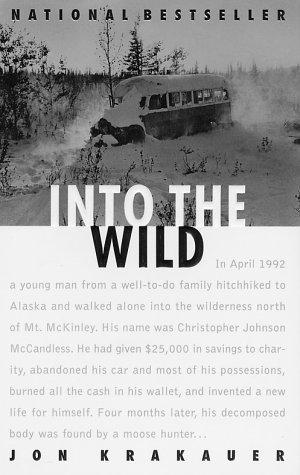
Into the Wild by Jon Krakauer was published in 1996. It grew out of a long article Krakauer wrote for Outside magazine in January 1993, after the death of a young man in Alaska became national news. The article drew more mail than anything the magazine had published. Krakauer spent more than a year following the young man's trail, and the book became a bestseller and, in 2007, a film directed by Sean Penn.
The book opens at the end. In April 1992, an electrician named Jim Gallien picks up a hitchhiker outside Fairbanks. The young man says his name is Alex. He wants a ride to the Stampede Trail, an old mining track that runs west into the bush north of Denali National Park. He carries a small rifle, a ten-pound bag of rice, and a few books. Gallien worries. He tries to talk Alex out of it, and gives him his own rubber boots. Alex hands Gallien his watch and the change in his pocket, and walks into the snow.
In September, moose hunters find a rusted city bus on the trail, about twenty miles in. A note on the door asks for help. Inside is a sleeping bag with the decomposed body of the young man. He weighs about 67 pounds. His name was Christopher Johnson McCandless.
Who Chris McCandless was
Chris was born in 1968 and grew up in Annandale, Virginia, a prosperous suburb of Washington, D.C. His father, Walt, was a gifted antenna engineer who had worked for NASA. His mother, Billie, ran a consulting business with him. Chris had a younger sister, Carine, to whom he was very close.
He was bright, stubborn and athletic. He ran cross-country in high school and pushed his teammates to train as if their lives depended on it. He read Tolstoy, Thoreau and Jack London, and he took their moral arguments seriously. He was generous with strangers and hard on the people closest to him. He criticized his parents' wealth and their comfortable life.
Krakauer reports a key source of Chris's anger. In his late teens, Chris learned that his father had kept up a relationship with his first wife after Chris was born, and had fathered another child with her. Chris saw his parents' marriage, and the respectable life they built on it, as a lie. He told no one but his sister how much it hurt.
Chris graduated from Emory University in Atlanta in 1990 with strong grades in history and anthropology. His parents offered to buy him a new car. He refused. Then, without telling his family, he gave his remaining savings of about $24,000 to Oxfam, a charity that fights hunger. He loaded his old yellow Datsun and drove west. He did not tell his family where he was going, and they never heard from him again.
Two years on the road
In the Lake Mead area of Arizona, a flash flood soaks Chris's car and engine. He abandons the car, burns the cash in his wallet, and continues on foot. He takes a new name, Alexander Supertramp.
For the next two years, he travels by thumb, freight train and canoe. Krakauer traces his route through the people he met:
- Wayne Westerberg, who runs a grain elevator in Carthage, South Dakota. He hires Chris for harvest work twice and becomes one of his closest friends. Chris sends him letters and postcards until the end.
- Jan Burres and her partner Bob, a couple who live on the road. Chris meets them in Northern California and again at the Slabs, a winter camp for drifters in the desert near the Salton Sea. Jan comes to think of him as a son.
- A trip by canoe down the Colorado River from Arizona into Mexico, toward the Gulf of California, where he gets lost in the delta and is pushed back by tides.
- Ronald Franz, an eighty-year-old widower in Salton City, California, who lost his own wife and son years before. Franz grows so attached to Chris that he asks to adopt him as a grandson. Chris tells him to sell his things and get out on the road. After Chris's death, Franz renounces God.
Krakauer uses these encounters to show a young man who drew people in and then moved on. Each person describes him as polite, funny, honest and stubborn. Several tried to help him with money or gear, and most of the time he refused.
The bus
Chris always planned to end his journey in Alaska, his great Alaskan odyssey. In April 1992, he reaches Fairbanks and buys a guide to edible plants. Gallien drops him at the Stampede Trail. In late April the Teklanika River is low and icy, and Chris crosses it easily.
About twenty miles in, he finds an old Fairbanks city bus, number 142, left by a road crew decades earlier and used by hunters as a shelter. He makes it his camp. He hunts squirrels, ducks, porcupines and grouse, and he gathers berries and roots. He keeps a short diary on the blank pages of his plant guide. He shoots a moose, but cannot dry the meat fast enough, and flies lay eggs in it. He calls it one of the greatest tragedies of his life.
He reads Tolstoy, Thoreau and Pasternak's Doctor Zhivago. In the margins he notes his thoughts. Next to a passage in Zhivago he writes that happiness is only real when shared.
In early July, after about two months, he decides to walk out. He packs up and returns to the Teklanika. It is now a torrent of glacial snowmelt, far too deep and fast to cross. He does not have a detailed map. If he had, he would have seen a hand-operated cable crossing a short distance downstream, and a ranger cabin a few miles away. He turns back to the bus.
His diary entries grow short. He writes about weakness and about being trapped. In mid-August he posts a note on the bus door asking for help. He takes a photo of himself, holding a final note in which he says he has had a happy life, says goodbye, and blesses everyone. He dies around August 18, 1992, after about 113 days in the bush.
What killed him
The obvious answer is starvation. Krakauer believed, and still argues, that something made it worse. Chris's diary mentions seeds of the wild potato plant, Hedysarum alpinum. In the first edition, Krakauer suggested the seeds contained a toxin that kept his body from using food. Labs found no such toxin, and critics said Krakauer was trying to excuse a simple mistake. In 2013, Krakauer wrote in The New Yorker that a neurotoxin in the seeds may cause paralysis in a starving person. Later research proposed another compound. Scientists still disagree, and many think he simply starved.
The author's own trip
Krakauer puts himself in the book. At twenty-three, in 1977, he set out alone to climb the Devils Thumb, a granite peak on the Stikine Icecap in Alaska. He had a strained relationship with his own demanding father and something to prove. He nearly died twice, failed, tried again and reached the summit. He writes that he survived largely by luck.
He argues that Chris was driven by the same restlessness that drove him, and that the difference between them was not sanity but chance.
Krakauer also tells the stories of other young men who went into the wild and did not return. Everett Ruess, a twenty-year-old artist, disappeared in the Utah canyons in 1934. Gene Rosellini tried to live like a Stone Age man in Alaska for years. Carl McCunn flew into the Alaskan bush to photograph wildlife in 1981, forgot to arrange a pickup, and died. Krakauer places Chris among them while arguing that he was more competent than people assumed.
What the critics say
Many Alaskans view Chris as arrogant and unprepared, a young man who walked into the bush without a map or enough food and died of his own mistakes. They resent the way the book romanticizes him. Others criticize Krakauer for projecting his own story onto Chris and for pushing the poison theory to protect his subject's reputation. The bus became a pilgrimage site. Several hikers had to be rescued, and two women drowned crossing the Teklanika, in 2010 and 2019. In June 2020, the Alaska Army National Guard removed the bus by helicopter. It is now held by the University of Alaska Museum of the North.
Who should read it
Read it if you want a gripping piece of reporting about risk, idealism and the pull of wilderness, or if you are deciding what you think of Chris McCandless. It suits anyone who has wanted to walk away from ordinary life, and anyone who has watched someone they love do it.