
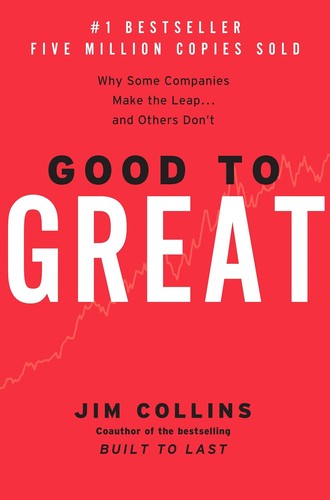
Jim Collins's five-year study of 11 companies that went from average stock returns to beating the market for 15 years. For managers who want the habits, not the hype, behind lasting performance.

Author · 1 summary
American management researcher and author
Jim Collins is a business researcher and author who studies why some companies become great and stay that way. He earned a degree in mathematical sciences at Stanford University in 1980, spent 18 months at McKinsey, and returned to Stanford for an MBA in 1983. After a short time as a product manager at Hewlett-Packard, he joined the faculty of the Stanford Graduate School of Business in 1988.
Built to Last (1994), written with Jerry Porras, compared long-lived visionary companies with their rivals and made his name. In 1995 he set up a management research laboratory in Boulder, Colorado, where he still works with business, nonprofit and military leaders.
Good to Great (2001) asks how an ordinary company becomes an outstanding one. His team screened 1,435 companies and found 11 that made the leap. Collins names the pattern: Level 5 leaders who mix humility with will, the right people on the bus first, facing hard facts, the Hedgehog Concept and the flywheel. Critics note that several of the 11, such as Circuit City and Fannie Mae, later declined or failed. Later books include How the Mighty Fall and Great by Choice.
Jim Collins's five-year study of 11 companies that went from average stock returns to beating the market for 15 years. For managers who want the habits, not the hype, behind lasting performance.
New books, occasionally